
Ductless Mini Split Versus Central Air for an Older Home
Compare ductless mini split versus central air for an older home, from installation costs to zoning and efficiency. Call (833)-700-4293 for contractor referrals.

Learn more about Central Air Conditioning Repair or Maintenance for guides, costs, and what to expect.
Compare Central Air Conditioning Repair or Maintenance Pros Near You

Enter your ZIP code to compare top-rated local professionals and request free quotes.
If your older home has radiators, baseboard heat, or window units, the question of how to add air conditioning can feel overwhelming. You are not just choosing a cooling system, you are deciding how much of your home's original character you are willing to sacrifice for comfort. The choice between a ductless mini split and central air is one of the most consequential and expensive decisions a homeowner will make, and it is especially tricky in older houses where ductwork may not exist or may be impossible to install without major renovation. This guide breaks down the real-world tradeoffs, costs, and performance differences so you can make an informed decision that fits your home and your budget.
Installation Complexity and Cost in Homes Without Ductwork
The single biggest factor that pushes older-home owners toward ductless systems is the absence of ductwork. Central air requires a network of supply and return ducts running through walls, floors, and attics. In a home built before 1970, those spaces are often cramped, finished, or filled with obstructions like knob-and-tube wiring, asbestos, or structural blocking. Retrofitting ducts can cost $5,000 to $15,000 or more, and that is before the equipment itself. You may also need to cut into original plaster walls, lower ceilings in basements, or sacrifice closet space for chases. In historic homes, these changes can trigger preservation review or simply destroy the aesthetic you love.
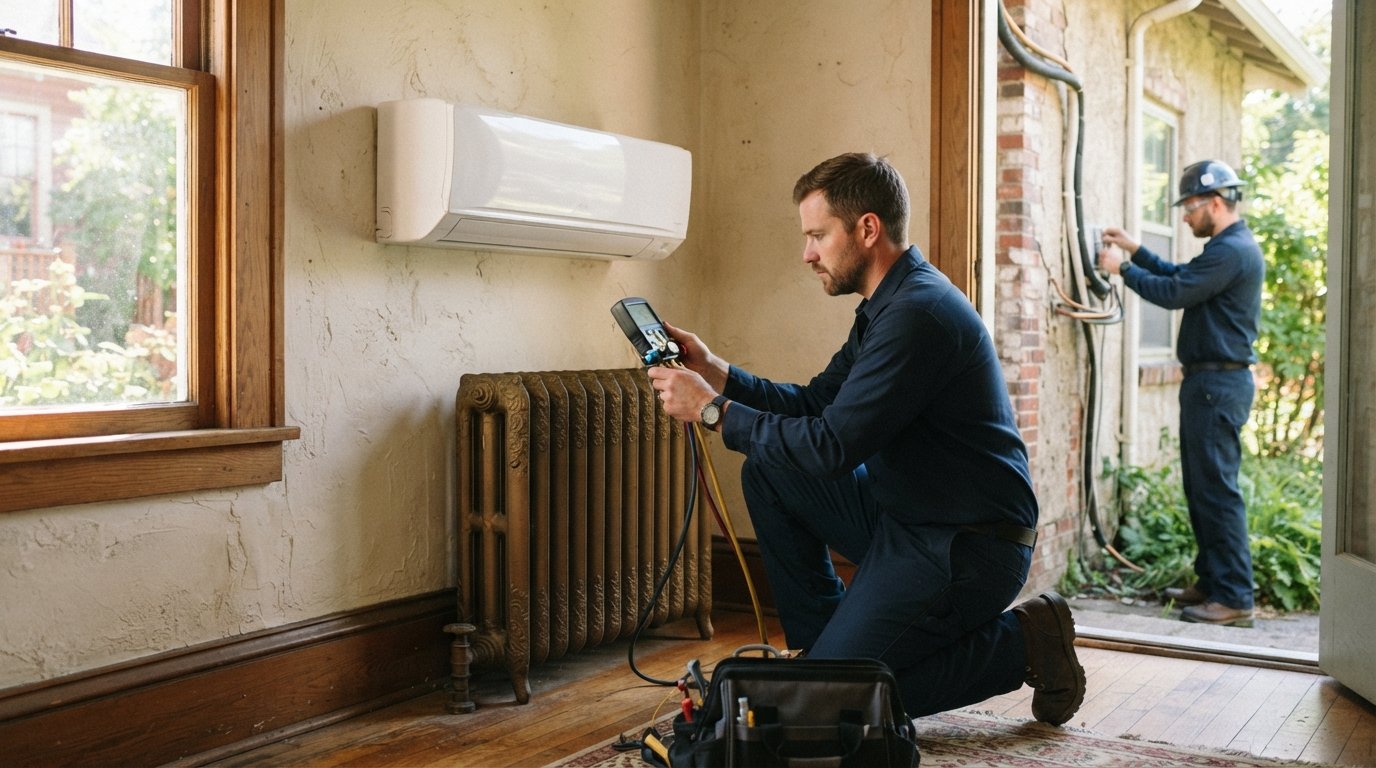
A ductless mini split, by contrast, requires only a three-inch hole through an exterior wall for each indoor unit. The compressor sits outside, and the indoor air handler mounts high on a wall or near the ceiling. Installation is far less invasive, often completed in a single day, and does not require the demolition and reconstruction that ductwork demands. For a typical three-bedroom older home, a multi-zone ductless system might cost $6,000 to $12,000 installed, while central air with new ductwork could easily exceed $20,000. That price gap is why many owners of older homes start their search with ductless in mind.
That said, central air can be the better value if your home already has usable ductwork, even if it needs sealing or minor repairs. If you have a forced-air furnace, you may be able to add an evaporator coil and condenser for $4,000 to $8,000, far less than a full ductless setup. The key is to have an HVAC contractor inspect your existing ducts for leaks, sizing, and layout before you assume they are unusable. A professional assessment is essential, and you can find pre-vetted local contractors through Homes.Contractors to get multiple opinions on whether your ducts are salvageable.
Room-by-Room Zoning Versus Whole-House Cooling
One of the most practical advantages of a ductless mini split is zoning. Each indoor unit has its own thermostat, so you can cool only the rooms you are using. In an older home with uneven temperatures, this is a game changer. You can keep the bedroom comfortable at night while the living room stays warmer, or cool a home office during the day without paying to chill the entire house. This flexibility often translates into lower energy bills because you are not conditioning square footage you do not need.
Central air, on the other hand, is a single-zone system unless you invest in motorized dampers and multiple thermostats, which adds cost and complexity. A traditional central system cools the whole house to one setpoint, and older homes often have poor air balance, meaning some rooms are always too hot or too cold. You can close registers, but that increases static pressure and can damage the blower. For a house with a closed-off addition or a rarely used guest room, central air is inefficient by design.
However, central air wins on uniformity when it is properly designed. A well-sealed and balanced duct system delivers consistent temperatures and filters the air across the entire home. If your older home has an open floor plan and you want every room to feel the same, central air provides a simplicity that multiple wall units cannot match. The tradeoff is that you lose the ability to customize comfort room by room without significant extra investment.
Aesthetics, Noise Levels, and Efficiency Ratings Compared
Ductless mini splits are visible. Each indoor unit is a white plastic box mounted on the wall, typically 30 to 40 inches wide and 8 to 12 inches tall. In a beautifully restored living room, that unit can feel like an eyesore. Manufacturers have improved designs, and some units can be recessed into ceilings or mounted low on the wall, but they are never truly invisible. Central air, by contrast, hides all its equipment in the basement, attic, or utility closet, with only small registers visible. For homeowners who have invested in period details, central air preserves the look of the home far better than wall-mounted units.
Noise is another differentiator. Ductless indoor units are extremely quiet, often operating at 19 to 30 decibels, quieter than a whisper. The compressor outside is comparable to a central air condenser. Central air systems produce noise at the registers and through the return, and older ductwork can amplify that sound with whistling or rattling. If your bedroom is adjacent to a mechanical closet, central air may keep you awake. Ductless units are generally the quieter choice indoors, but the outdoor compressor still makes noise, so placement matters.
Efficiency ratings favor ductless in most comparisons. Mini splits are inverter-driven, meaning they modulate compressor speed to match load rather than cycling on and off at full blast. This leads to higher seasonal energy efficiency ratios (SEER) and better humidity control. Many ductless systems achieve SEER ratings of 20 to 30, while central air systems typically range from 14 to 18 SEER. However, central air efficiency is measured at the air handler, and duct losses can reduce real-world performance by 20 to 30 percent in older homes. A high-efficiency central system with leaky ducts may underperform a mid-tier ductless system. For a deeper look at how warranties interact with these systems, see our guide on contractor warranty versus home warranty explained.
Cold-Climate Performance and Heating Capability
Modern ductless mini splits are not just air conditioners. They are heat pumps that can provide both cooling and heating, and their cold-climate performance has improved dramatically. Many models now operate efficiently down to 5 degrees Fahrenheit and can continue to produce heat at minus 13 degrees, though capacity declines as temperatures drop. For an older home in a mild or moderate climate, a ductless heat pump can replace both your window AC and your electric baseboard heat, saving significant money on winter bills. In colder regions, you may need a backup heat source or a cold-climate-specific model, which costs more but still qualifies for federal tax credits and local rebates.
Central air conditioners do not heat. If you choose central air, you will still rely on your existing furnace, boiler, or baseboard heat in winter. That means you are maintaining two separate systems and two sets of fuel costs. A central heat pump is an option, but it requires ductwork and often struggles in very cold climates without auxiliary electric resistance heat, which is expensive to run. For older homes with hydronic heating, a ductless heat pump can provide supplemental heating in shoulder seasons without firing up the boiler, which is a major comfort and efficiency win.
It is important to size a cold-climate heat pump correctly. Oversizing leads to short cycling and poor humidity control in summer, while undersizing leaves you cold in winter. An HVAC contractor should perform a Manual J load calculation, not just guess based on square footage. Older homes often have poor insulation and air sealing, so the load calculation must account for those realities. If you are unsure how to vet a contractor for this work, PlanRemodel's directory of pre-vetted professionals can help you compare quotes and credentials.
Maintenance Needs and Expected Lifespan
Both systems require regular maintenance, but the tasks differ. Ductless mini splits have washable filters that you should clean every two to four weeks during heavy use, and the indoor coil and blower wheel need professional cleaning annually. The outdoor unit needs coil cleaning and refrigerant level checks. Because there are multiple indoor units, maintenance costs can add up if you have five or six zones. However, you can often service units yourself for basic filter cleaning, and there are no ducts to leak or seal.
Central air systems require annual professional maintenance that includes checking refrigerant, cleaning the condenser and evaporator coils, inspecting the blower, and, critically, sealing and cleaning ducts. Duct leakage is a major hidden cost in older homes, and leaky ducts can draw in dust, mold spores, and attic air. Duct cleaning every few years may be necessary, and duct sealing can cost $1,000 to $3,000. The equipment itself typically lasts 15 to 20 years for a central air conditioner, while ductless mini splits often last 15 to 20 years as well, though compressors may need replacement around year 12 to 15. Inverter boards and specialized parts can be expensive out of warranty.
Here is a quick comparison of key maintenance and lifespan factors:
- Ductless mini split: Quarterly filter cleaning, annual professional coil cleaning per indoor unit, no duct maintenance, 15 to 20 year lifespan, higher parts cost for electronics.
- Central air: Annual professional maintenance, duct inspection and sealing every 3 to 5 years, filter changes every 1 to 3 months, 15 to 20 year lifespan, lower equipment cost but higher duct-related expenses.
- Warranty coverage: Both systems typically offer 5 to 10 year parts warranties, but labor warranties vary by installer, so choose a contractor with a strong labor guarantee.
For older homes, the maintenance burden often tilts toward central air because ductwork is a silent liability. If your ducts are leaky, dirty, or poorly insulated, you will pay for that inefficiency every month. Ductless systems eliminate that variable but introduce multiple filters and indoor units that need attention. Neither system is maintenance-free, but ductless is more forgiving if you are diligent about filter cleaning.
Making the Decision for Your Older Home
The right choice depends on your home's existing infrastructure, your climate, your budget, and your tolerance for visible equipment. If your older home has no ductwork and you want to avoid major renovation, a ductless mini split is almost always the more practical and cost-effective path. It preserves original walls and plaster, offers room-by-room comfort, and provides efficient heating in shoulder seasons. If you have usable ductwork or are planning a major renovation that includes duct installation, central air may deliver better aesthetics and uniform comfort for a lower total cost.
Before you commit, get at least three quotes from licensed HVAC contractors who have experience with older homes. Ask each one to perform a load calculation, inspect existing ducts (if any), and explain the expected operating costs in writing. A good contractor will not push one system universally; they will assess your specific house and recommend the best fit. PlanRemodel can connect you with pre-vetted local pros who understand the challenges of retrofitting comfort systems into older structures, so you can compare options and make a confident decision.