
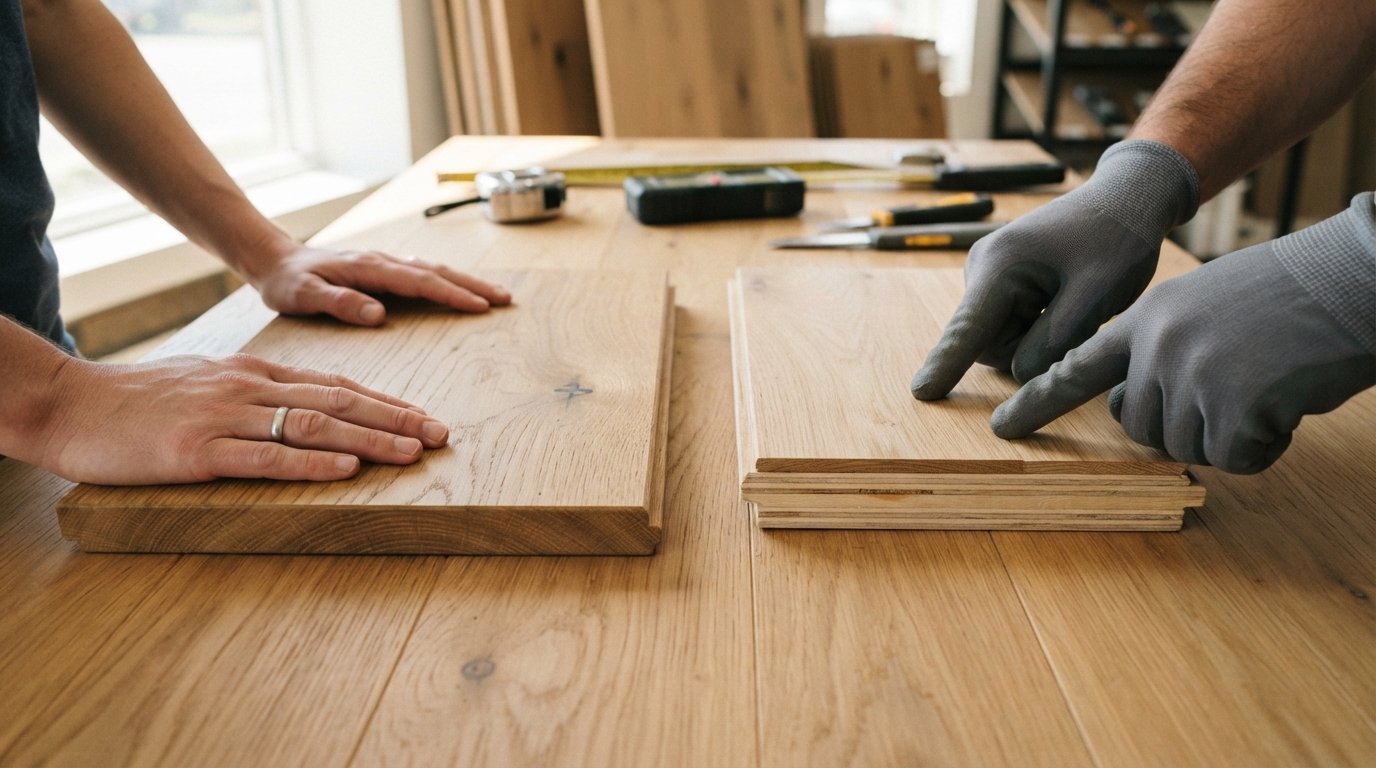
Hardwood versus Engineered Wood Flooring: A 2026 Comparison
Compare hardwood versus engineered wood flooring on cost, durability, and resale. Call (833)-700-4293 to find pre-vetted local flooring pros.

Learn more about Floor Installation or Replacement for guides, costs, and what to expect.
Compare Floor Installation or Replacement Pros Near You

Enter your ZIP code to compare top-rated local professionals and request free quotes.
Choosing between hardwood and engineered wood flooring is one of the most consequential decisions in a home renovation. Both options promise the warmth and character of real wood, but they differ dramatically in construction, cost, durability, and long-term performance. The right choice depends on your subfloor, climate, budget, and how long you plan to stay in your home. This hardwood versus engineered wood flooring comparison breaks down everything you need to know, from how each plank is built to how they hold up over decades, so you can specify the right material with confidence.
How Hardwood and Engineered Wood Are Constructed
Solid hardwood flooring is exactly what it sounds like: each plank is a single piece of wood, milled from a species such as oak, maple, or hickory. The thickness typically ranges from 3/4 inch to 5/16 inch, and the wear layer is the full thickness of the plank. Because it is a solid piece of wood, it responds to moisture and temperature changes by expanding and contracting across its width. This characteristic makes solid hardwood sensitive to humidity swings and generally unsuitable for installation below grade or directly over concrete.
Engineered wood flooring, by contrast, is built from multiple layers of wood veneer or plywood bonded together with adhesive. The top layer, known as the wear layer or lamina, is a slice of real hardwood, usually between 1/16 inch and 1/4 inch thick. The core layers are arranged in a cross-ply construction, which gives the plank dimensional stability and resistance to moisture. This construction allows engineered wood to be installed over concrete slabs, in basements, and in rooms with fluctuating humidity, provided the product is rated for those conditions.
The practical implication for homeowners is significant. Solid hardwood can be sanded and refinished many times over its life, often five to ten times depending on wear layer thickness. Engineered wood can be refinished only if its wear layer is thick enough (typically 1/8 inch or more), and many entry-level engineered products cannot be refinished at all. This difference affects long-term maintenance costs and the ability to renew the floor's appearance after years of wear.
Cost Per Square Foot and Typical Lifespan
Cost is often the first filter in any flooring decision. Solid hardwood flooring generally ranges from $6 to $12 per square foot for materials, with installation adding $3 to $6 per square foot. The total installed cost typically falls between $9 and $18 per square foot, depending on species, grade, and local labor rates. Exotic species and wide-plank formats can push costs higher. Engineered wood flooring is usually less expensive, with materials ranging from $3 to $9 per square foot and installation costs similar to solid hardwood, bringing the installed total to roughly $6 to $15 per square foot. High-end engineered products with thick wear layers can approach solid hardwood pricing.
Lifespan follows a similar split. Solid hardwood, when properly maintained and refinished periodically, can last 50 to 100 years or more. It is often considered a permanent improvement that adds lasting value to a home. Engineered wood typically lasts 20 to 40 years, depending on wear layer thickness and quality of construction. Thicker wear layers and quality cores extend the lifespan, while thin, entry-level products may need replacement after 15 to 20 years. For homeowners planning to stay in their home for decades, solid hardwood often represents a better long-term investment; for those planning to move within 10 to 15 years, engineered wood can deliver similar visual appeal at a lower upfront cost.
It is worth noting that installation method affects cost as well. Solid hardwood is typically nailed or stapled to a wood subfloor, while engineered wood can be floated, glued, or stapled, depending on the product and subfloor. Floating installations over concrete can save on labor, further narrowing the cost gap in basements and slab-on-grade homes.
Performance Over Concrete Slabs and in Humid Climates
One of the most important distinctions in this hardwood versus engineered wood flooring comparison is how each performs over concrete and in humid environments. Solid hardwood is generally not recommended for installation directly over concrete slabs because it cannot tolerate the moisture vapor that concrete emits. Even with a vapor barrier, the risk of cupping, buckling, and gapping is high. Solid hardwood also performs poorly in basements and in climates with significant seasonal humidity swings, where it may expand and contract enough to create visible gaps or squeaks.
Engineered wood is engineered precisely for these conditions. Its cross-ply construction resists moisture-related movement, and many products are approved for installation over concrete with an appropriate underlayment or adhesive. This makes engineered wood a practical choice for basements, slab-on-grade homes, and regions with high humidity. In humid climates such as the Southeast and Gulf Coast, engineered wood is often the only realistic wood flooring option for ground-level and below-grade installations. Homeowners in these areas should look for products with a moisture-resistant core and follow manufacturer guidelines for acclimation and vapor barriers.
That said, engineered wood is not waterproof. Standing water and prolonged moisture can still damage it, so it is not a substitute for luxury vinyl or tile in bathrooms and laundry rooms. In humid climates, proper HVAC and dehumidification remain important for both types of flooring. For homeowners comparing options, the key takeaway is that engineered wood offers greater dimensional stability and installation flexibility, while solid hardwood demands more stable conditions and is best suited to above-grade installations over wood subfloors.
Resale Value and Buyer Perception
Real wood flooring, whether solid or engineered, is consistently viewed favorably by homebuyers. A 2024 survey by the National Association of Realtors found that hardwood flooring was among the features most likely to add value to a home, with buyers willing to pay more for homes with wood floors. The perception of hardwood as a premium, durable, and timeless material remains strong. Engineered wood, when it looks and feels like real wood, is often indistinguishable to buyers and can deliver a similar visual impact at a lower price point.
However, the resale value story is nuanced. Solid hardwood may command a slight premium in buyer perception, particularly in higher-end markets where original hardwood floors are a selling point. Engineered wood can be equally attractive, but buyers may scrutinize the wear layer thickness and brand quality. In general, both options can improve resale value compared to carpet or vinyl, but the return on investment depends on the home's price point and neighborhood. For homeowners planning to sell within a few years, engineered wood offers a way to achieve the wood look without the higher upfront cost of solid hardwood.
It is also worth considering that some buyers may prefer the authenticity of solid hardwood, while others value the stability and modern construction of engineered wood. In homes with concrete subfloors or basements, engineered wood may be the only wood option, and buyers in those markets understand and appreciate that. The best approach is to choose a product that fits the home's architecture and price tier, and to keep documentation of the product's specifications for future buyers.
Maintenance Routines and Warranty Differences
Maintenance requirements for solid and engineered wood are similar in daily life: sweep or vacuum regularly, use a damp mop with a pH-neutral cleaner, and avoid standing water. Both benefit from felt pads under furniture and rugs in high-traffic areas. However, long-term maintenance differs because of refinishing. Solid hardwood can be sanded and refinished multiple times, allowing homeowners to erase scratches, dents, and stains and change the floor's color. Engineered wood can be refinished only if the wear layer is thick enough, and many products cannot be refinished at all. For engineered wood, maintenance often means spot repairs or replacement of individual planks rather than a full refinish.
Warranty coverage reflects these differences. Solid hardwood warranties from manufacturers often cover structural integrity for 25 years to lifetime, with finish warranties typically ranging from 5 to 25 years. Engineered wood warranties vary widely: entry-level products may offer 10 to 15 years on the finish and 20 to 30 years on structural integrity, while premium engineered products can offer 30-year or lifetime structural warranties and 20 to 30-year finish warranties. It is important to read the fine print, as warranties may be voided by improper installation, moisture damage, or use of incompatible cleaning products.
For homeowners who want the ability to refinish and customize their floors over time, solid hardwood offers more flexibility. For those who prefer a stable, low-maintenance floor with a long finish warranty, engineered wood can be an excellent choice. In either case, proper installation by a qualified professional is essential to preserving warranty coverage. This is where a resource like Homes.Contractors can help: it is a comprehensive online directory and informational resource for homeowners in the United States seeking qualified, pre-vetted contractors for home improvement and repair services, including flooring installation. Connecting with experienced local installers ensures your floor is installed to manufacturer specifications, protecting your investment and your warranty.
Making the Right Choice for Your Home
The decision between hardwood and engineered wood comes down to your specific circumstances. Consider the following factors as you evaluate your options:
- Subfloor and location: Solid hardwood is best for above-grade installations over wood subfloors. Engineered wood is the practical choice for concrete slabs, basements, and humid climates.
- Budget and timeline: Engineered wood offers a lower upfront cost and can be a better fit for shorter ownership horizons. Solid hardwood costs more but can last a lifetime and be refinished multiple times.
- Refinishing plans: If you want the ability to sand and refinish in the future, choose solid hardwood or an engineered product with a thick wear layer (1/8 inch or more).
- Resale goals: Both options appeal to buyers, but solid hardwood may carry a slight premium in higher-end markets. Engineered wood delivers the wood look at a lower price point.
- Maintenance preferences: Both require similar routine care, but solid hardwood offers more long-term renewal options.
Once you have a clear picture of your needs, the next step is to gather quotes from qualified flooring contractors. Requesting multiple estimates allows you to compare pricing, installation methods, and warranty terms, and to verify that the contractor has experience with your chosen material. Homeowners can use PlanRemodel.com to connect with pre-vetted local contractors, request free estimates, and review ratings by state. This hardwood versus engineered wood flooring comparison is a starting point; a knowledgeable contractor can help you finalize the choice based on your home's specific conditions and your long-term goals.
Whichever material you choose, investing in quality installation and proper acclimation will pay off in performance and longevity. Wood flooring, whether solid or engineered, remains one of the most desirable features in a home, and with the right product and professional installation, it can deliver beauty and value for decades.
Learn more about Floor Installation or Replacement for guides, costs, and what to expect.
Compare Floor Installation or Replacement Pros Near You
Enter your ZIP code to compare top-rated local professionals and request free quotes.