
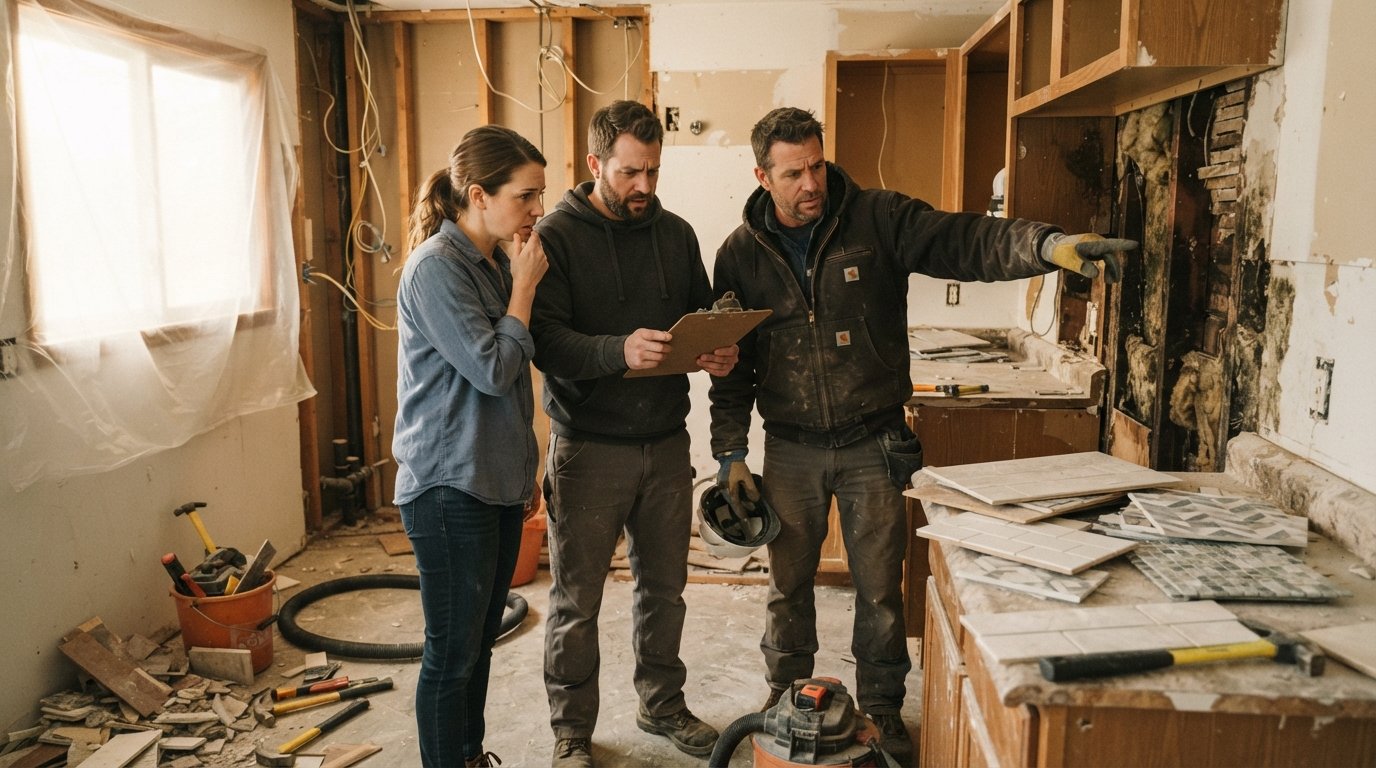
Hidden Costs That Blow Up a Home Remodel Budget
Hidden costs that blow up a home remodel budget are predictable. Plan ahead and avoid surprise bills. Call 8337004293 for trusted local contractor referrals.

By Laura Bennett
Learn more about General Contracting for guides, costs, and what to expect.
Compare General Contracting Pros Near You

Enter your ZIP code to compare top-rated local professionals and request free quotes.
You signed the contract, picked the tile, and set aside what you thought was a comfortable cushion. Then the change orders start, the walls come down, and the numbers climb. Most homeowners plan for the visible expenses: labor, materials, permits, and finishes. The trouble usually hides in the spaces between those line items, and those gaps are exactly where a carefully planned remodel goes sideways.
The good news is that most budget blowups are predictable once you know where to look. Hidden costs are rarely random acts of bad luck. They follow patterns: surprises behind the drywall, scope creep, permit delays, and allowances that never matched reality. Learning those patterns before you swing a hammer, or before you hire anyone, is the single most effective way to protect your budget.
This guide breaks down the hidden costs that blow up a home remodel budget, why they happen, and how to plan for them so a mid-project crisis does not turn into a financial one. Whether you are updating a bathroom, finishing a basement, or rethinking the whole kitchen, the same principles apply.
Why Remodel Budgets Drift So Easily
A remodel is not a product you buy off a shelf. It is a project with dozens of unknowns, many of which only reveal themselves after demolition begins. Contractors can estimate what they can see, but they cannot see through walls, under floors, or into the history of your home. That uncertainty is baked into every remodel, and it is why even honest, experienced professionals leave room for contingencies in their bids.
The problem is that homeowners often treat the initial bid as the final price. In reality, the bid is a snapshot of known conditions. When conditions change, so does the price. A responsible contractor documents those changes with change orders, but each one adds cost and time. A project that starts at $40,000 can quietly climb to $52,000 without anyone acting in bad faith. The difference is not drama. It is a series of small, mundane surprises that were never priced in.
The other driver is human nature. Once a project starts, decisions feel more urgent and more emotional. You are standing in a half-finished room, you can finally picture the result, and that upgraded countertop or extra recessed lighting feels worth it. Scope creep is one of the most common hidden costs because it does not feel like a cost at the time. It feels like progress.
The Most Common Hidden Costs Homeowners Miss
Most budget overruns trace back to a handful of recurring culprits. None of them are exotic, and all of them are manageable if you plan for them before signing anything. Here are the ones that show up again and again.
- Surprises behind the walls: outdated wiring, corroded plumbing, mold, asbestos, or structural damage that only appears after demolition.
- Permit and inspection fees: application costs, re-inspection charges, and delays when plans do not match code.
- Allowance gaps: bids that use low allowances for tile, fixtures, or appliances that cost far more in reality.
- Change orders: mid-project additions or upgrades that add labor, materials, and scheduling pressure.
- Disposal and dumpster costs: hauling debris, especially for heavy materials like tile, concrete, or old cabinetry.
Each of these can add thousands of dollars to a project. Together, they are the reason so many homeowners end up borrowing more than they planned or pausing a project halfway through. The fix is not to avoid remodeling. It is to build these possibilities into your budget from day one.
Surprises Behind the Walls and Under the Floor
This is the category that catches almost everyone. Your home was built at a specific moment in time, using the materials and methods of that era. When you open up a wall, you may find galvanized pipes that are one repair away from failing, knob-and-tube wiring that cannot support modern loads, or framing that does not meet current code. In older homes, asbestos and lead paint are real possibilities, and their safe removal requires licensed specialists.
These discoveries are not signs of a bad contractor. They are the nature of renovation. What matters is how they are handled. A thorough contractor will flag likely risks during the estimate and recommend a contingency fund. A less thorough one will bid low, win the job, and then present change orders once the walls are open and you have no choice but to proceed.
One practical safeguard is to ask for a pre-demolition inspection or a limited exploratory opening in high-risk areas. It costs a little upfront but can reveal problems while you still have time to adjust the scope or budget. If you are working with a referral service like Homes.Contractors, you can compare multiple pre-vetted contractors and ask each how they handle unforeseen conditions. The answers will tell you a lot about who you are hiring.
Permits, Inspections, and Code Compliance
Permits are not just paperwork. They are a legal requirement in most jurisdictions and a signal to your contractor that the work will be inspected. Skipping them can lead to fines, forced removal of finished work, and disclosure problems when you sell. Even when permits are pulled correctly, they carry costs that homeowners often forget to include.
Beyond the permit fee itself, there are inspection fees, re-inspection fees if something fails, and the cost of correcting work that does not meet code. There is also the cost of time. Inspections require scheduling, and a failed inspection can stall the entire project for days or weeks, which means labor crews are idle or rescheduled. On a large remodel, that delay can be more expensive than the permit itself.
Code compliance can also force upgrades you did not plan for. Adding a bathroom may trigger requirements for ventilation, GFCI outlets, or updated plumbing. Replacing a roof may require added insulation or updated flashing details. These are not optional. They are the price of doing the work legally and safely, and they belong in your budget from the start.
Allowances: The Quiet Budget Killer
An allowance is a placeholder number in a contract for items not yet selected, such as tile, lighting, plumbing fixtures, or appliances. Allowances are useful because they let the project move forward before every finish is chosen. They are also one of the easiest places for a budget to unravel.
Here is the trap. A contractor may set a tile allowance at $4 per square foot because that is a reasonable entry-level price. But once you visit the showroom, you fall in love with a $12 per square foot option. Multiply that difference across a kitchen backsplash, a bathroom floor, and a shower surround, and you have added thousands of dollars without changing the scope of work at all.
The fix is simple but requires discipline. Before signing, review every allowance line and ask what it actually buys. Then visit showrooms and price the finishes you genuinely want. If your taste runs above the allowance, either raise the allowance now or adjust your selections. Do not assume you will be happy with the cheaper option later. You probably will not be.
Change Orders and Scope Creep
A change order is a formal adjustment to the contract, usually adding cost and time. Some change orders are unavoidable, such as when hidden damage is discovered. Others are optional, driven by new ideas or upgrades that feel small in the moment. Both types add up.
Scope creep is the optional kind, and it is the most dangerous because it feels harmless. While the electrician is already there, you add a few outlets. While the walls are open, you decide to move a doorway. While the tile guy is on site, you upgrade the grout. Each decision is small. Collectively, they can add 15 to 25 percent to a project.
A simple framework helps here. Before the project starts, write down your must-haves and your nice-to-haves. Keep a separate line in your budget for upgrades, and treat it as a hard limit. When a new idea appears, ask three questions: Does it change the function of the space? Does it require new permits or inspections? Does it push the timeline? If the answer to any is yes, pause and price it before agreeing.
Disposal, Dumpsters, and Logistics
Remodeling generates a surprising amount of waste. Old cabinets, countertops, flooring, drywall, and packaging all have to go somewhere. Dumpster rental, hauling fees, and landfill charges are real costs, and they vary widely by region and by material. Heavy debris like concrete or tile can require special handling and higher fees.
Logistics add another layer. If your home has limited driveway access, the contractor may need a smaller dumpster and more frequent pickups. If you live in a historic district or an HOA, there may be rules about dumpster placement and duration. If your street requires permits for construction vehicles, that is another fee. None of these are glamorous, but they are real.
Ask your contractor how disposal is handled and whether it is included in the bid. Some contractors include a standard dumpster and exclude extra hauls. Others leave it entirely to the homeowner. Clarify this before work begins so you are not surprised by a $600 hauling bill in week three.
Design Fees, Engineering, and Professional Services
Not every remodel needs an architect, but many benefit from one. Structural changes, load-bearing wall removals, and major additions usually require stamped drawings from an engineer or architect. These services are billed separately from construction and can add several thousand dollars to a project.
Design fees are not wasted money. Good design prevents expensive mistakes and can often save more than it costs by optimizing layouts and materials. But they are a line item that homeowners frequently forget to include when they set their total budget. The same is true for surveys, energy assessments, and specialty inspections.
If you are planning a significant remodel, ask your contractor which professional services will be required and get estimates for each. If you are unsure where to start, a directory like Homes.Contractors can help you find qualified local professionals, including those who handle design and engineering, so you can build a complete budget rather than a partial one.
Timeline Delays and Their Real Cost
Time is money in a remodel, and delays are expensive in ways that are not always obvious. Material prices can change between order and delivery. Rental equipment accrues daily charges. Temporary housing, storage units, and eating out because your kitchen is unusable all add up. If you are living in the home during construction, the stress and cost of a longer timeline are real.
Some delays are unavoidable, such as weather or backordered materials. Others are preventable. Incomplete plans, late selections, and slow decision-making are the most common causes of homeowner-driven delays. Every day the crew cannot work is a day they may need to be rescheduled, which can push your project back by weeks.
To protect your timeline, make selections early, respond to questions quickly, and keep a single decision-maker in charge. If multiple people have to agree on every choice, build that into the schedule. A remodel that runs smoothly is usually one where the homeowner treated decisions as part of the job.
How to Build a Realistic Contingency Fund
The single most effective defense against hidden costs is a contingency fund. This is money set aside specifically for the unexpected. It is not a slush fund for upgrades. It is insurance against reality.
Industry guidance varies, but a common recommendation is 10 to 15 percent of the total project cost for well-planned remodels, and 20 percent or more for older homes or projects with significant unknowns. If your budget is $50,000, that means setting aside $5,000 to $10,000 that you hope not to spend. If you do not need it, you have a cushion. If you do, you are not scrambling for a credit card.
Here is a simple way to structure your budget:
- Estimate the base project cost from multiple contractor quotes.
- Add known soft costs: permits, design, engineering, and inspections.
- Add a realistic allowance buffer for finishes and fixtures.
- Add a contingency of 10 to 20 percent based on the age and condition of your home.
- Keep a separate, smaller fund for optional upgrades, and treat it as a hard cap.
This structure turns a vague number into a plan. It also gives you a clear way to evaluate contractor bids. A bid that is significantly lower than others is often a bid that has left out soft costs or underestimated allowances. Comparing multiple quotes side by side, which is exactly what a referral platform like PlanRemodel is designed to support, helps you spot those gaps before they become your problem.
Questions to Ask Before You Sign
The best time to uncover hidden costs is before the contract is signed. Ask direct questions and expect clear answers. A contractor who is comfortable with transparency will welcome them. One who is evasive is telling you something important.
- How do you handle unforeseen conditions, and what does a typical change order look like?
- Are permits, inspections, and disposal included in this bid, or billed separately?
- What allowances are built into this contract, and what do they actually cover?
- What is your payment schedule, and how much is due before work begins?
- How do you communicate schedule changes, and who is my main point of contact?
Ask for answers in writing. A written scope, a written allowance schedule, and a written change-order process protect both sides. They also make it much harder for small misunderstandings to become large bills.
Working With the Right Contractor Matters More Than the Bid
Hidden costs are not just about money. They are about trust, communication, and process. A contractor who explains risks upfront, documents changes, and keeps you informed is worth more than one who simply quotes the lowest number. The lowest bid is often the one with the most hidden costs baked in.
This is where a pre-vetted referral service earns its value. Instead of calling random numbers and hoping for the best, you can request multiple quotes from qualified local contractors, compare their approaches, and choose the one who plans for reality rather than the one who promises the impossible. You can also check localized ratings and read educational guides that help you ask better questions.
The goal is not to eliminate every surprise. That is not possible in remodeling. The goal is to make surprises manageable, so a hidden cost becomes a planned expense instead of a crisis. Homeowners who budget for the unknown, verify their contractor, and stay disciplined about scope consistently finish their projects with fewer regrets and healthier bank accounts.
Start with a realistic number, add a contingency, ask hard questions, and choose your contractor carefully. Do that, and the hidden costs that blow up a home remodel budget become far less likely to blow up yours.