
How to Verify Contractor References and Past Work
Verify contractor references and past work with confidence. Call (833)-700-4293 to connect with pre-vetted local pros and avoid costly hiring mistakes.

By Wendy Turner
Learn more about Construction Services for guides, costs, and what to expect.
Compare Construction Services Pros Near You

Enter your ZIP code to compare top-rated local professionals and request free quotes.
You have a contractor's estimate in hand, a start date penciled in, and a deposit on the line. Before you sign, the single most important step is verifying that the contractor's references and past projects are real, recent, and relevant to your job. A polished website and a friendly sales pitch can hide poor workmanship, missed deadlines, and financial trouble. Learning how to verify contractor references and past work is the difference between a smooth renovation and a costly, months-long headache.
This guide walks you through a practical, field-tested process: what to ask each reference, how to inspect past jobs in person or through photos and permits, which red flags demand a walk-away, and how to cross-check references against state licensing records. By the end, you will have a repeatable system that protects your home and your wallet.
Why Reference Checks Matter More Than Ever
Contractor fraud and shoddy work are not rare exceptions. State licensing boards regularly report complaints about unlicensed operators, abandoned jobs, and deposits that vanish. Homeowners who skip reference checks often discover too late that a contractor's insurance lapsed, that the crew was actually a string of day laborers, or that the "completed projects" shown in a portfolio were never finished. The stakes are high: a botched roof can leak for years, an improperly wired panel can be a fire hazard, and a half-finished bathroom can cost tens of thousands to correct.
Verifying references and past work does three things. First, it confirms the contractor has actually done the type of work you need, at a scale and quality you expect. Second, it gives you a preview of how the contractor handles problems, communicates, and respects schedules and budgets. Third, it creates a paper trail you can rely on if a dispute arises. In many states, a documented reference check can even strengthen your position in a licensing complaint or small claims case.
Before You Call: Gather the Right Information
Start by asking the contractor for a reference list in writing. A serious professional will provide names, phone numbers, project addresses, and dates without hesitation. If you get a vague "call my buddy" or a list of names with no contact details, that is your first warning sign. Ask for at least three references from projects completed in the last 12 to 24 months, and request a mix: two similar in scope to your job and one that involved a problem or change order.
Also collect the contractor's license number, insurance certificate, and a sample written contract before you make calls. You will use these to cross-check what references tell you. For example, if a reference says the job was done in 2019 but the contractor's license was only issued in 2022, that is a discrepancy worth exploring. Having the paperwork in front of you keeps the conversation focused and makes it harder for a contractor to give you a curated list of friendly references.
Questions to Ask Each Reference (and What Trouble Sounds Like)
Most homeowners ask, "Were you happy with the work?" That question invites a polite yes. Instead, ask specific, behavior-based questions that require details. A good reference will happily share them; a coached or fake reference will stumble, give vague answers, or repeat the same script. Here are the core questions to ask every reference:
- What was the scope of your project, and how close was the final price to the original estimate? (Listen for whether change orders were reasonable and documented.)
- How did the contractor communicate during the job, and how quickly did they respond to questions or concerns?
- Did the crew show up when promised, and how did the contractor handle any delays?
- Were there any problems during the project, and how were they resolved?
- Would you hire this contractor again for a similar project, and why or why not?
Pay attention to tone as much as content. Hesitation, long pauses, or answers that sound rehearsed are warning signs. So is faint praise: "They were fine, I guess" or "It worked out eventually" often hides a difficult experience. Ask a follow-up: "If you could change one thing about how the project went, what would it be?" A genuine reference will have a thoughtful answer; a fake one will deflect. Also ask whether the reference knows anyone else who used the contractor, and whether you can see the finished work. A real customer will usually offer.
Red flags to listen for include references who cannot recall basic details (project cost, timeline, scope), references who are clearly reading from a script, and references who all give identical stories. If every reference says the exact same thing in the same order, you are likely talking to friends or employees, not independent customers. Another warning sign: references who mention the contractor asked them to leave a positive online review before the job was even finished.
Reviewing Past Projects in Person or Through Photos and Permits
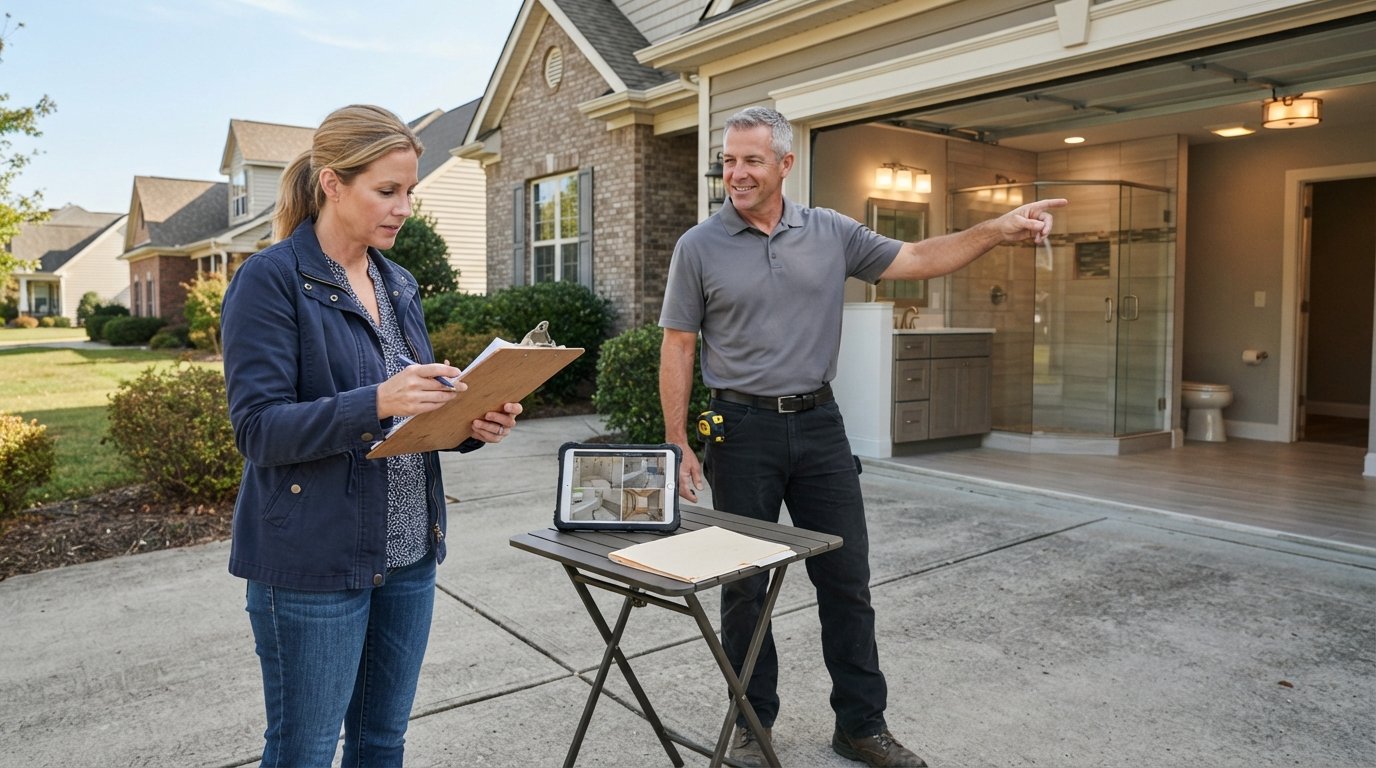
Whenever possible, ask to visit a completed project in person. Seeing the work up close reveals details photos can hide: clean caulk lines, level tile, proper flashing on a roof, neatly run conduit, and finish quality on trim and paint. Ask the homeowner to point out what they are most and least happy with. If an in-person visit is not possible (for example, the project is out of state), ask for a photo set that includes before, during, and after images, plus close-ups of key details.
Photos alone can be misleading, so cross-check them against permits. Most jurisdictions publish permit records online, and you can search by address or contractor license number. A permit record will tell you when the permit was pulled, what scope of work was approved, and whether inspections were passed. If a contractor claims to have remodeled a kitchen but no permit exists for structural, electrical, or plumbing work, that is a serious red flag. In many areas, homeowners can also request inspection histories, which show whether the work passed or required corrections.
For roofing, HVAC, electrical, and plumbing projects, permits are especially important because these systems affect safety and insurance. Ask the contractor for the permit number for each reference project, then verify it yourself. If the contractor hesitates or says permits were not needed, confirm that claim with your local building department. A contractor who routinely skips permits is a contractor who may cut corners elsewhere. You can also ask references whether the contractor pulled permits and whether the final inspection was completed before final payment.
Cross-Checking References Against State Licensing Records
Every reference check should include a licensing cross-check. Most states have a free online license lookup tool, usually run by the state's contractor licensing board or department of consumer affairs. Search the contractor's license number and name, then confirm four things: the license is active, it covers the type of work you need, it has no serious disciplinary actions, and the business name and address match what you were given.
Look closely at the license history. A license that was issued recently but claims decades of experience is a mismatch. A license with a suspension, revocation, or multiple complaints deserves scrutiny. Some states publish complaint records and disciplinary actions, which can reveal patterns of poor workmanship or financial mismanagement. Also check whether the contractor carries general liability insurance and workers' compensation; you can usually verify this by requesting a certificate of insurance directly from the insurer or agent, not just a photocopy from the contractor.
If your state does not license the specific trade (some states do not license roofers or handymen), look for local registration requirements and check with your city or county building department. A contractor who cannot produce a license or registration when one is required should be removed from your list. Cross-checking references against licensing records is not about catching every bad actor; it is about confirming that the person you are about to hire is who they say they are and is accountable to a regulator.
Red Flags in Inconsistent References or Vague Job Descriptions
Inconsistency is the most reliable red flag in reference checking. If one reference says the job took three weeks and another says three months for a similar scope, ask why. If references give different company names or different owner names, you may be dealing with a subcontractor arrangement or a business that changes names frequently. Vague job descriptions are equally troubling: "They did some work on my house" tells you nothing. A real customer can describe the project, the materials, the timeline, and the outcome.
Other red flags include references who are listed with no phone number or only an email, references who turn out to be relatives or employees, and contractors who refuse to provide written references. Be wary of a contractor who offers a discount for a positive review or who pressures you to skip the reference step because "we are busy and trust is important." Trust is earned through transparency, not urgency. If a contractor becomes defensive when you ask for references or permit numbers, that reaction is information.
Finally, watch for references that sound like they are describing a different contractor. If the reference mentions a different owner, a different crew size, or a different specialty, the contractor may be borrowing references from another business. Ask the reference to confirm the company name and the owner's name. A brief pause or a correction is a sign that the list was not assembled honestly.
Building a Simple Verification Framework
To keep the process manageable, use a simple scoring framework. For each contractor, create a one-page sheet with columns for license status, insurance, permit verification, reference quality, and photo or site review. Score each item from 1 to 5, and note any discrepancies. This turns a subjective gut feeling into a comparable record you can review with your family or partner.
- Request three references in writing, with contact details and project dates.
- Call each reference and ask the five core questions, noting tone and specifics.
- Verify permits for each reference project through your local building department.
- Cross-check the contractor's license and insurance with state records and the insurer.
- Review photos or visit a completed project, focusing on details and finish quality.
After you complete the steps, compare your notes across contractors. A contractor with slightly higher pricing but clean permits, enthusiastic references, and a verified license is usually the safer choice. A low bid with vague references and no permit history is a false economy. For homeowners who want a head start, resources like Homes.Contractors offer directories and educational guides that can help you identify pre-vetted professionals and understand what to check before you hire.
Putting It All Together Before You Sign
Verification is not a one-time phone call; it is a short, structured investigation. Give yourself a week to gather references, make calls, check permits, and review license records. Keep copies of everything: the reference list, your notes, permit numbers, insurance certificates, and the written contract. If something feels off, ask one more question rather than talking yourself into a decision. The best contractors expect due diligence and respect you for doing it.
When you are ready to compare options, request multiple written quotes and ask each contractor the same verification questions. This side-by-side approach makes inconsistencies obvious and gives you leverage to negotiate. Remember that the goal is not to find a perfect contractor; it is to find a professional whose references, permits, and license all tell the same story. Do that, and your project starts on solid ground.
Learn more about Construction Services for guides, costs, and what to expect.
Compare Construction Services Pros Near You
Enter your ZIP code to compare top-rated local professionals and request free quotes.