
DIY vs Professional Home Repair: When to Hire in 2026
DIY versus professional home repair decisions get easier with a clear risk framework. Call (833)-700-4293 to connect with vetted local contractors today.

By Isaac Ellis
Learn more about General Contracting for guides, costs, and what to expect.
Compare General Contracting Pros Near You

Enter your ZIP code to compare top-rated local professionals and request free quotes.
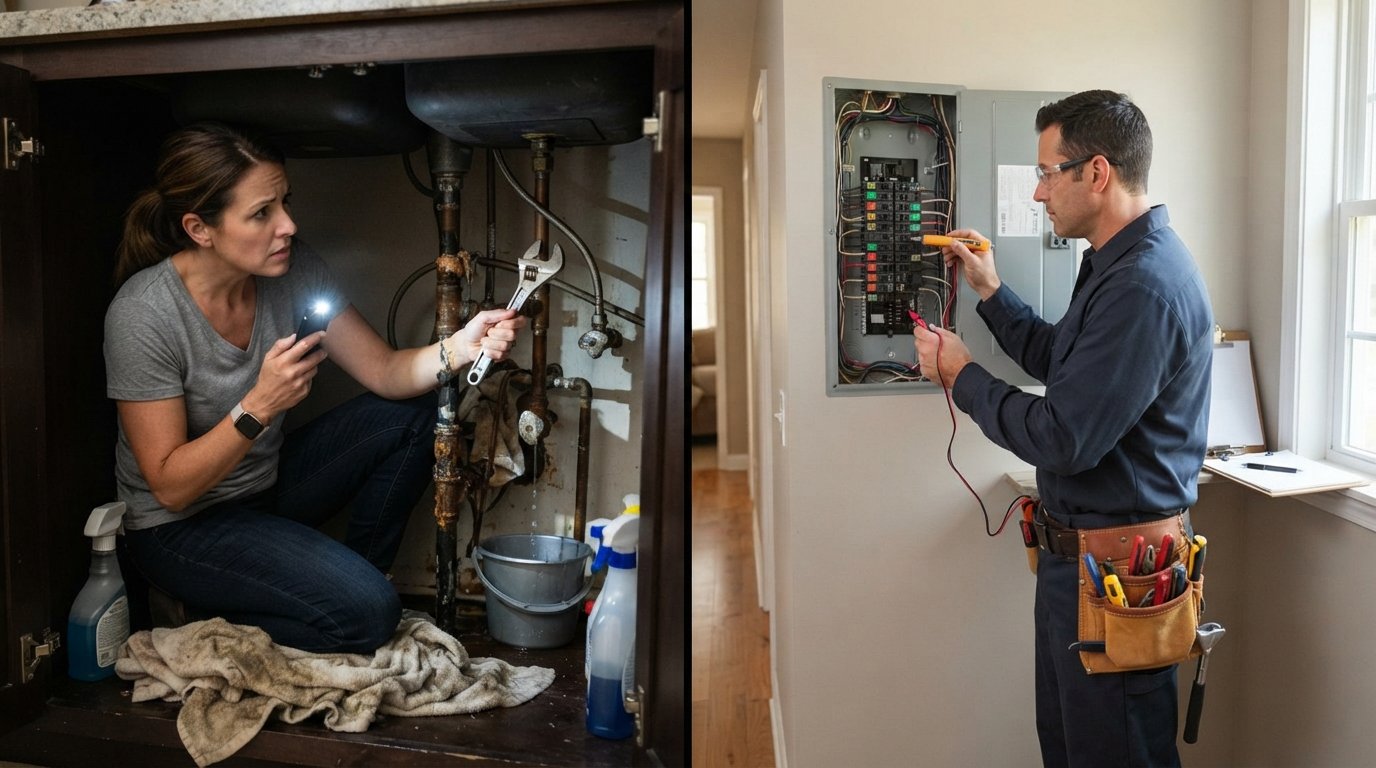
Your Saturday morning starts with a dripping faucet, and by noon you are watching a YouTube tutorial with a wrench in one hand and your phone in the other. Home repair decisions rarely feel this simple, though. That small leak can hide corroded pipes, a failing shutoff valve, or water damage that has been spreading behind the wall for months. Knowing when to pick up the tools yourself and when to call in a licensed professional is one of the most valuable skills a homeowner can develop, and it directly affects your safety, your budget, and the long-term value of your property.
The DIY versus professional home repair debate is not about whether you are handy enough. It is about matching the task to your skills, your available time, your local code requirements, and the real cost of getting it wrong. This guide breaks down the decision into practical frameworks so you can stop guessing and start planning with confidence.
Why the DIY Versus Professional Home Repair Decision Matters More Than Ever
Home repair costs have climbed steadily, and the pressure to save money by doing the work yourself is stronger than ever. At the same time, modern homes are more complex than the houses your grandparents maintained. Tankless water heaters, smart electrical panels, multi-zone HVAC systems, and engineered roofing materials all demand specialized knowledge that a general handyman skill set may not cover.
The stakes go beyond money. An improperly installed gas line can be lethal. A roof repair done without proper flashing can lead to thousands of dollars in water damage within a single rainy season. Electrical work that bypasses code can void your homeowner insurance and create fire hazards that stay hidden for years. On the flip side, hiring a professional for every minor task can drain your savings and leave you dependent on contractors for jobs you could easily handle yourself.
The goal is not to avoid DIY or avoid professionals. It is to draw a clear, rational line between the two based on risk, complexity, and return on your time. That line looks different for every homeowner, but the framework for finding it is surprisingly consistent.
Assessing Your DIY Readiness Before You Start
Before you decide to tackle a repair yourself, run an honest self-assessment. Most DIY failures do not happen because the homeowner lacked talent. They happen because the homeowner misjudged the scope, the tools required, or the consequences of a mistake.
Ask yourself these questions and answer them without ego:
- Do I have prior experience with this specific type of repair, or am I learning from scratch?
- Do I own or have safe access to the tools this job requires, including any specialty equipment?
- Can I complete this within a reasonable timeframe without disrupting my household?
- Am I physically capable of the work, including lifting, climbing, and working in tight spaces?
- If something goes wrong, can I afford to pay a professional to fix my mistake on top of the original repair cost?
If you answered no to more than one of these questions, the project is probably better suited for a licensed professional. That is not a failure. It is smart risk management. The homeowners who get into the most trouble are the ones who overestimate their abilities on high-stakes repairs and underestimate the cost of correcting a botched job.
There is also a time factor that many people overlook. A repair that takes a professional three hours might take you three weekends. If those weekends cost you family time, missed work, or the use of a critical part of your home, the true cost of DIY is much higher than the materials receipt suggests.
Projects That Are Usually Safe for DIY
Not every repair carries the same risk. There is a wide category of home maintenance and improvement tasks that are genuinely beginner-friendly, low-risk, and rewarding to complete yourself. These jobs build confidence and save real money without putting your home or your safety on the line.
Common DIY-friendly projects include painting interior walls and trim, replacing light switch covers and outlet plates, caulking tubs and sinks, unclogging drains with a plunger or snake, replacing faucet aerators, installing shelving and closet organizers, patching small drywall holes, and replacing air filters in your HVAC system. Landscaping, gutter cleaning, and pressure washing also fall into this category for most homeowners.
These tasks share a few traits: they are reversible, they do not involve gas or high-voltage electricity, they do not require permits in most jurisdictions, and mistakes are visible and easy to correct. If you make a mess caulking your bathtub, you scrape it out and try again. If you make a mistake wiring a new circuit into your breaker panel, you could burn your house down.
Even within the DIY-friendly category, it pays to do your homework first. Watch a full tutorial, read the manufacturer instructions, and gather all your materials before you start. Half-finished projects that drag on for weeks often end up costing more than hiring someone in the first place.
Projects That Demand a Licensed Professional
Certain repairs cross a line where the risk to your safety, your home, and your legal standing becomes too high to justify DIY. These are the jobs where hiring a licensed, insured professional is not just smart but often required by law.
Any work involving natural gas lines, electrical panel upgrades, new circuit installation, structural modifications, sewer line repairs, roof replacement, asbestos or mold remediation, and major plumbing rough-in should always go to a licensed trade professional. Many of these tasks require permits and inspections, and unpermitted work can create serious problems when you try to sell your home.
Consider what is at stake. A gas leak can cause an explosion. Faulty electrical work causes tens of thousands of house fires every year in the United States. Structural mistakes can lead to sagging floors, cracked foundations, or worse. Even if you are confident in your mechanical skills, the liability and insurance implications alone make professional help the only responsible choice.
There is also the warranty and resale angle. If a licensed plumber installs your new water heater and it fails within the warranty period, you have recourse. If you install it yourself and it floods your basement, you are on your own. When you sell your home, buyers and inspectors will ask about permits and professional installation for major systems. Unpermitted DIY work can delay or derail a sale.
If you are unsure whether a repair falls into this category, err on the side of caution. A quick call to your local building department or a licensed contractor can clarify whether a permit is required, and that answer usually tells you everything you need to know about whether the job is DIY-appropriate.
A Practical Framework for Making the Call
When you are staring at a repair and you genuinely do not know which way to go, use a simple scoring approach. Evaluate the job across four dimensions and assign each a score from one to five, where one is low risk and five is high risk.
The four dimensions are safety risk, code and permit requirements, complexity of the repair, and the cost of failure. Add up your scores. If the total is below eight, DIY is probably fine. Between eight and fourteen, get at least one professional quote before you decide. Above fourteen, hire a licensed professional without hesitation.
Here is how that looks in practice. Replacing a bathroom faucet scores low on safety, low on permits, moderate on complexity, and low on failure cost, so it is a clear DIY. Replacing a section of your roof after storm damage scores high on safety, high on permits in some areas, high on complexity, and very high on failure cost, so it is a clear professional job. Replacing a toilet sits somewhere in the middle, which is why many homeowners handle it themselves while others prefer to hire a plumber.
This framework removes emotion from the decision. It also gives you a defensible reason to hand off a project you simply do not want to do, which is perfectly valid. Your time and peace of mind have value, and a repair that stresses you out for weeks is not a bargain even if you save money on labor.
Understanding the Real Cost of DIY Mistakes
The most common argument for DIY is cost savings, and on paper it usually looks compelling. A contractor might charge several hundred or several thousand dollars for a job where the materials cost a fraction of that. But that comparison ignores the cost of what happens when the repair goes wrong.
Water damage from a poorly sealed shower can rot subflooring and framing, leading to repair bills in the thousands. An incorrectly installed electrical outlet can cause a fire that your insurance company may refuse to cover if the work was unpermitted. A roof patch that fails during the next storm can lead to ceiling collapse and mold remediation. These are not rare edge cases. They are the predictable result of taking on work that exceeds your skill level.
There is also the hidden cost of your own time. If you spend forty hours on a project that a professional would complete in eight, you have effectively paid yourself a very low hourly wage once you factor in trips to the hardware store, research, and rework. For high earners or busy parents, the math almost never favors DIY on large projects.
None of this means you should avoid DIY entirely. It means you should price in the risk. When the downside of failure is small and recoverable, DIY is a great choice. When the downside is catastrophic, the professional premium is money well spent.
How to Hire the Right Professional When You Need One
Once you have decided to hire a professional, the next challenge is finding someone qualified, insured, and trustworthy. This is where many homeowners get stuck, because the contractor market is fragmented and quality varies widely.
Start by getting multiple quotes. A single bid gives you no context for whether the price is fair or the scope is complete. Three quotes is the standard minimum, and it gives you a chance to compare not just price but professionalism, communication style, and the thoroughness of each proposal. Ask each contractor for references from similar projects completed in the last year, and actually call those references.
Verify licensing and insurance before any work begins. Every state has a licensing board or registry where you can confirm that a contractor is authorized to perform the work. Ask for a certificate of insurance and call the insurer to confirm the policy is active. This step takes ten minutes and can save you from a financial disaster if a worker is injured on your property.
For homeowners who want to streamline this process, resources like Homes.Contractors provide directories of pre-vetted professionals across roofing, HVAC, plumbing, and remodeling, along with educational guides that explain what to expect at each stage of a project. Using a vetted directory narrows the field to contractors who have already met basic credential and insurance requirements, which saves time and reduces risk.
If your project involves the roof, our guide on roof repair or replacement decisions walks through how to evaluate whether a repair is sufficient or whether full replacement is the smarter investment. That kind of project-specific context makes it much easier to have an informed conversation with the contractors you interview.
Special Considerations for Different Types of Repairs
Not all repairs carry the same decision logic. Plumbing, electrical, roofing, and HVAC each have their own risk profiles and regulatory requirements that should shape your DIY versus professional calculus.
Plumbing repairs range from trivial to complex. Replacing a showerhead or fixing a running toilet is well within reach for most homeowners. Replacing a water heater, repairing a sewer line, or rerouting supply pipes requires a licensed plumber in most jurisdictions, and for good reason. Water damage is expensive and often hidden until it is severe.
Electrical work is the category where DIY carries the highest risk of catastrophe. Changing a light fixture is manageable for a careful homeowner who turns off the breaker and verifies the circuit is dead. Adding a new outlet, replacing a breaker panel, or installing a ceiling fan where no fixture existed requires a licensed electrician and usually a permit. The consequences of error are fire and electrocution, which is not a risk worth taking to save a few hundred dollars.
Roofing and HVAC sit in a middle zone. Minor roof repairs like replacing a few shingles or sealing a small leak can be DIY for confident homeowners with the right safety equipment. But roof replacement, flashing repair around chimneys, and any work on steep or high roofs should go to professionals. HVAC work involving refrigerant, gas lines, or system replacement requires licensed technicians, while filter changes and basic maintenance are homeowner tasks.
When to Get Quotes Even If You Plan to DIY
One of the most underused strategies in home repair is getting professional quotes even when you intend to do the work yourself. A quote is not a commitment. It is information. When a contractor walks your project and explains what they would do, you learn about scope, materials, and potential complications you might not have considered.
This is especially valuable for mid-range projects where you are not sure whether to DIY or hire. Getting two or three quotes gives you a benchmark for the true market cost of the work. If the quotes come in lower than you expected, hiring might be the better call. If they come in much higher, you can decide whether the savings justify the effort and risk of doing it yourself.
Quotes also help you avoid the trap of underestimating a project. Homeowners routinely budget for the visible part of a repair and forget about the permits, the disposal fees, the inspection costs, and the contingency for surprises behind the wall. A professional quote typically accounts for all of these, which gives you a more realistic picture of what the job actually involves.
Building a Long-Term Maintenance Strategy
The best way to reduce the number of emergency repair decisions you face is to stay ahead of maintenance. Homes that are maintained on a schedule experience fewer catastrophic failures, and when something does break, it is often caught early when the repair is small and the DIY versus professional question is easier to answer.
Create a seasonal maintenance calendar that covers your roof, gutters, HVAC system, plumbing fixtures, and exterior paint. Inspect your attic and crawlspace for signs of moisture or pests at least twice a year. Replace HVAC filters on schedule. Test your sump pump before the rainy season. These small tasks take a few hours per season and prevent the kind of damage that turns a minor repair into a major renovation.
As you build that maintenance habit, you will also build a clearer picture of your own capabilities. You will learn which tasks you enjoy and do well, and which ones you dread. That self-knowledge makes every future DIY versus professional decision faster and more confident. For homeowners in the United States who want a structured way to find and compare qualified local contractors when the time comes, the resources available through PlanRemodel can turn a stressful search into a straightforward process.
The right answer to the DIY versus professional home repair question is not a fixed rule. It is a habit of honest self-assessment, respect for risk, and willingness to invest in quality when the stakes justify it. Master that habit, and you will protect your home, your budget, and your peace of mind for years to come.