
How to Tell If Your Home Needs a Whole House Rewiring
Spot the signs your home needs a whole house rewiring. Call (833)-700-4293 to compare local electricians and avoid surprise repair bills.

By Patrick Owens
Learn more about Electrical and Wiring Repair for guides, costs, and what to expect.
Compare Electrical and Wiring Repair Pros Near You

Enter your ZIP code to compare top-rated local professionals and request free quotes.
Flickering lights, warm outlets, and a fuse box that trips every time the microwave runs are more than minor annoyances. In older homes, these symptoms often point to a wiring system that has reached the end of its safe service life. Understanding how to know if your home is ready for a whole house rewiring can mean the difference between a planned upgrade and an emergency repair, or worse, an electrical fire. This guide walks you through the warning signs, the professional assessment process, the real costs, and how to coordinate a rewiring project with other renovations so you can make a confident, informed decision.
Warning Signs Your Home May Need Whole House Rewiring
Electrical wiring is designed to last decades, but it does not last forever. The insulation dries out and cracks, connections loosen, and the demands of modern appliances far exceed what older systems were built to handle. Certain materials and configurations are red flags that warrant immediate attention from a licensed electrician.
Aluminum wiring, common in homes built between the late 1960s and mid-1970s, is a well-documented fire hazard. Aluminum expands and contracts more than copper, which causes connections at outlets and switches to loosen over time. Loose connections create resistance, and resistance creates heat. If your home has aluminum branch circuit wiring, a full replacement is often the safest long-term solution, though specialized pigtailing can be a temporary fix in some cases.
Knob-and-tube wiring, found in homes built before the 1950s, lacks a grounding conductor entirely. The cloth insulation becomes brittle with age, and the ceramic knobs and tubes offer no protection against moisture or physical damage. Insurance companies increasingly refuse to cover homes with active knob-and-tube wiring, which is a strong signal that rewiring is not just advisable but necessary for maintaining coverage.
Overloaded panels present another clear warning. If your electrical panel is a fuse box rather than a circuit breaker panel, or if the panel is packed with tandem breakers and still trips regularly, the system cannot safely distribute power to modern loads. A panel upgrade may suffice in some cases, but if the branch wiring itself is undersized or deteriorated, a whole-house rewiring is the more durable answer.
Beyond these material and equipment clues, pay attention to how your home behaves. A short list of symptoms that should prompt a professional evaluation includes:
- Outlets or switch plates that feel warm or show scorch marks
- Frequent tripping of breakers or blowing of fuses, especially when using ordinary appliances
- A burning smell near outlets or in the basement, which warrants an immediate call to an electrician
- Two-prong outlets with no ground, common in older homes and inadequate for sensitive electronics
- Lights that dim or flicker when appliances cycle on, suggesting loose connections or an overloaded circuit
Individually, these issues might be repairable with a targeted fix. In combination, or in a home with known legacy wiring materials, they point toward a systemic problem that patch repairs will only temporarily mask. A qualified electrician can tell you which category your home falls into.
How an Electrician Assesses Your Wiring During an Inspection
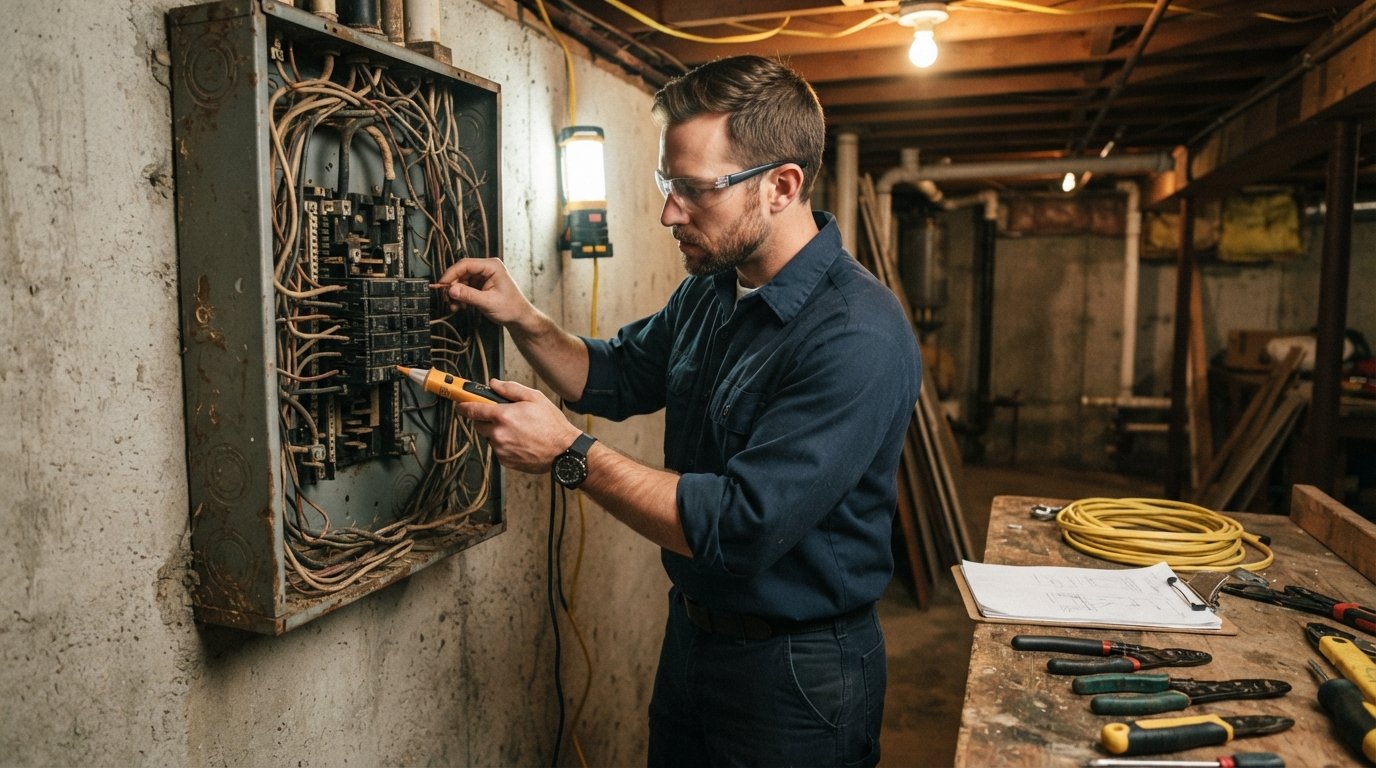
A professional evaluation is the most reliable way to answer the question of whether your home is ready for a whole house rewiring. During a pre-purchase inspection or a dedicated electrical safety inspection, an electrician examines both the visible components and the hidden infrastructure. The process typically begins at the panel, where the electrician identifies the type of wiring, checks for double-tapped breakers, verifies grounding, and looks for signs of overheating. From there, the inspection moves through representative outlets, switches, and fixtures to sample the condition of the branch circuits.
Electricians also use specialized tools to detect problems that are invisible to the eye. Thermal imaging can reveal hot spots behind walls, while circuit testers verify grounding and polarity at each outlet. In homes with suspected aluminum or knob-and-tube wiring, the electrician may open a few wall cavities or remove outlet covers to confirm what is actually installed. This matters because previous owners sometimes made partial upgrades, leaving a confusing mix of old and new wiring that is difficult to assess from the surface.
The inspection report should give you a clear picture of three things: the type and condition of the existing wiring, the capacity of the service panel relative to your household demand, and a prioritized list of safety issues. A good electrician will separate urgent hazards from long-term recommendations. You can then request multiple quotes for the recommended work so you can compare scope, pricing, and timelines. If you are also weighing plumbing upgrades, our guide on whole house repiping cost and when it is necessary explains how to evaluate a similar whole-system decision.
Do not rely on a general home inspector alone for this assessment. Home inspectors are trained to spot visible defects, but they are not electricians and cannot fully evaluate the condition of wiring inside walls. A dedicated electrical inspection, especially in a home older than 40 years, is a small investment that can prevent a very large surprise.
Typical Costs and Disruption for Whole House Rewiring
Whole house rewiring is a significant project, and homeowners should approach it with realistic expectations about both budget and lifestyle impact. Costs vary widely based on the size of the home, the region, the accessibility of the wiring, and whether the walls are open due to other renovations. As a broad range, homeowners can expect to pay several thousand to well over ten thousand dollars for a complete rewiring, with larger homes and complex layouts pushing toward the higher end.
Several factors drive the final price. The square footage of the home and the number of circuits required are primary drivers, since more outlets, switches, and dedicated circuits mean more labor and materials. The presence of aluminum or knob-and-tube wiring can add cost because removal and replacement require extra care. If the panel must be upgraded to handle the new circuits, that adds to the total. Homes with finished basements, plaster walls, or limited attic and crawlspace access are more labor-intensive to rewire, which increases the cost.
Disruption is the other major consideration. A whole-house rewiring involves cutting small openings in walls and ceilings to fish new cable, then patching and painting afterward. In most cases, the electrician can keep the power on for most of the home during the project, but there will be periods of downtime for specific circuits. Many homeowners choose to combine rewiring with a larger renovation so the wall openings are already part of the plan. If you are planning a major project, coordinating the electrical work with the rest of the renovation is both cheaper and less disruptive.
To keep the project manageable, consider the following practical steps:
- Get at least three detailed quotes that specify the number of circuits, the type of wiring, and whether patching and painting are included.
- Ask each electrician to walk you through the sequence of work and how long the power will be off in each area.
- Plan for temporary relocation of sensitive electronics and consider a short stay elsewhere if the work is extensive.
- Confirm permit requirements with your local building department before work begins, since inspections are part of the process.
- Budget for cosmetic repairs, because patching drywall and repainting are rarely included in the electrical bid.
Financing is another option worth exploring. Some homeowners use home equity lines of credit or dedicated improvement loans to spread the cost. The key is to avoid deferring safety-critical work in favor of cosmetic upgrades. A safe electrical system protects the entire investment you have made in your home.
Coordinating Rewiring with Renovations and Panel Upgrades
The smartest time to rewire a home is when the walls are already open. If you are planning a kitchen remodel, a basement finish, or a room addition, the incremental cost of extending the rewiring to the rest of the house is often much lower than doing it as a standalone project later. Contractors can coordinate schedules so the electrician roughs in new wiring before drywall goes up, and the same inspection can cover both the new work and the upgraded circuits.
Panel upgrades are a natural companion to rewiring. If your current panel is a fuse box or an older panel with limited capacity, replacing it with a modern breaker panel gives you the capacity to support new circuits, dedicated appliance lines, and future additions like an electric vehicle charger or a heat pump. In many jurisdictions, a panel upgrade triggers a requirement to bring other aspects of the electrical system up to current code, so it is worth discussing the scope with your electrician and your local building department early.
If you are remodeling a kitchen or bathroom, the electrical work is already a line item in the budget. Extending that work to include new wiring for adjacent rooms, or upgrading the service panel while the walls are open, is a cost-effective way to address the whole system. The same logic applies to HVAC upgrades: new high-efficiency equipment often requires dedicated circuits, and a rewiring project is the right time to add them.
Finding a qualified electrician for a project of this size is critical. A directory of pre-vetted home improvement contractors can help you identify licensed professionals in your area, request multiple quotes, and compare scope and pricing before you commit. Look for electricians who are licensed, insured, and experienced with older homes, and ask for references from similar projects. A thorough vetting process now saves headaches later.
Making the Decision: Repair, Upgrade, or Rewire
Not every electrical problem requires a whole-house rewiring. A single failed outlet, a worn switch, or a tripping breaker on one circuit can often be resolved with a targeted repair. The decision to rewire should be based on the overall condition of the system, the presence of legacy wiring materials, and the capacity of the panel to meet your household's needs. If your home has aluminum or knob-and-tube wiring, or if the panel is outdated and overloaded, a full rewiring is usually the most reliable path to safety and code compliance.
Timing matters as well. If you are planning to sell your home in the near future, a rewiring project can be a significant selling point, especially in markets where buyers are cautious about older homes. If you are planning to stay, the peace of mind and the ability to use modern appliances safely are worth the investment. Either way, the decision should be informed by a professional inspection rather than guesswork.
Start by scheduling an electrical safety inspection with a licensed electrician. Use the findings to request detailed quotes, and compare them carefully. If the scope is substantial, consider combining the work with other planned renovations to reduce disruption and cost. With the right information and the right professionals, you can move forward with confidence and protect your home for decades to come.