
Main Sewer Line Replacement Cost: What Homeowners Pay
See typical costs to replace a main sewer line and what drives the price. Call (833)-700-4293 to compare vetted local contractors and avoid surprise bills.

By Valerie Reed
Learn more about Construction Services for guides, costs, and what to expect.
Compare Construction Services Pros Near You

Enter your ZIP code to compare top-rated local professionals and request free quotes.
A backed-up drain that keeps returning after every plunge is more than an inconvenience. It is often the first warning that the main sewer line running beneath your yard has failed. For most homeowners, the immediate question is simple and urgent: how much does it cost to replace a main sewer line? The answer typically falls between $4,000 and $25,000, with most projects landing somewhere near $8,000 to $12,000. That range is wide because the final price depends on pipe length, depth, material, access, local labor rates, and whether the job requires tearing up a lawn or can be completed with a trenchless method. This guide breaks down those variables so you can budget with confidence, ask contractors the right questions, and avoid surprise bills when the excavator arrives.
Why Sewer Line Replacement Costs Vary So Much
No two sewer lines are identical, and that is the core reason quotes swing by thousands of dollars. A main line is the pipe that carries all wastewater from your home to the municipal sewer or septic system. It usually runs from the foundation to the street or the back of the lot, and its length, depth, and surrounding soil all influence the price. A short 30-foot run through soft soil in a warm climate is a very different project from a 100-foot run beneath a mature oak tree, a concrete driveway, or a finished basement slab.
Labor is the largest single line item in most estimates, often accounting for 40 to 60 percent of the total. Plumbers and excavation crews charge different rates by region, and urban areas with high demand and tight access cost more than rural areas with easy digging. Pipe material matters too: PVC is inexpensive and durable, cast iron and clay are common in older homes, and Orangeburg pipe (a tar-paper product used from the 1940s to the 1970s) is notoriously fragile and often collapses entirely. The table below shows typical national ranges for the most common scenarios.
- Spot repair of a short section: $500 to $3,000, depending on depth and access.
- Trenchless pipe lining (no digging): $4,000 to $12,000 for a typical residential run.
- Pipe bursting (replacing pipe while pulling new pipe through): $6,000 to $15,000.
- Open excavation replacement: $8,000 to $25,000, with yard and hardscape restoration adding more.
- Emergency after-hours replacement: add 20 to 50 percent to any of the above.
These figures are national averages. A homeowner in a high-cost metro may pay 30 percent more, while a homeowner in a lower-cost region with easy access may pay less. Always request at least three itemized quotes so you can compare labor, materials, permits, and restoration as separate lines rather than one lump sum.
Repair or Replace: What Triggers a Full Sewer Line Job
The decision between a spot repair and a full replacement usually comes down to the condition of the pipe, not just the location of the current clog. A single crack, a root intrusion at one joint, or a small bellied section can often be repaired for a fraction of replacement cost. But when the camera inspection reveals widespread deterioration, multiple breaks, offset joints, or a collapsed section, patching becomes a temporary fix that will fail again. Homeowners should think in terms of remaining life: a 60-year-old clay pipe with three repaired sections is a candidate for replacement, while a 15-year-old PVC line with one root intrusion is a candidate for repair.
Recurring backups are the most common trigger. If you have cleared the same line three times in two years, the pipe is telling you something. Slow drains throughout the house, gurgling toilets, sewage odors in the yard, and soggy patches of grass above the line are all signs that the main line is failing. In severe cases, raw sewage may back up into the lowest drain in the home, which is both a health hazard and a sign that the line is nearly blocked. Ignoring these warnings rarely saves money; emergency replacement after a full collapse typically costs more because crews must work faster, restore more damage, and sometimes address contaminated soil.
A professional camera inspection is the single most valuable step before any decision. A small camera travels the line and records the interior, revealing cracks, roots, scale, bellies, and the pipe material itself. Ask the contractor to share the video and mark the problem areas with footage timestamps. That recording is your evidence for choosing repair versus replacement, and it also protects you from being sold a full replacement when a targeted repair would do. For homeowners who also rely on a sump pump to manage water, keeping that system maintained is equally important; our guide on testing and maintaining a sump pump explains a simple seasonal routine that prevents avoidable water problems.
Camera Inspection Findings That Determine the Approach
The camera report is the roadmap for the entire project, and different findings point to different methods. Understanding what the technician sees helps you evaluate whether a quote makes sense. Here is how common findings translate into recommendations.
- Isolated crack or root intrusion at one joint: spot repair or localized lining is usually sufficient.
- Multiple cracks, offset joints, or heavy root infiltration along a run: full replacement or a continuous liner is the durable fix.
- Pipe belly (a sagging section that holds water): the sagging section must be corrected, often by excavation or pipe bursting, because lining cannot fix a loss of slope.
- Collapsed or crushed pipe: open excavation or pipe bursting, since lining requires a round, intact host pipe.
- Orangeburg or deteriorated cast iron: replacement is almost always recommended because the material has reached the end of its service life.
Depth is another factor the camera and locator reveal. A line four feet deep is straightforward; a line ten feet deep beneath a mature landscape requires shoring, larger equipment, and more labor. The locator also marks the exact path of the pipe so the crew knows where to dig and whether the line crosses a driveway, patio, or utility corridor. Ask for the depth and length in the written estimate, because those two numbers drive the price more than any other variable.
Trenchless Methods vs. Open Excavation: Cost and Tradeoffs
Trenchless technology has changed the economics of sewer replacement, but it is not always cheaper. Trenchless lining, often called cured-in-place pipe (CIPP), involves inserting a resin-saturated liner into the existing pipe and curing it in place. It creates a new pipe inside the old one with minimal digging, which protects lawns, driveways, and mature trees. Lining typically costs $4,000 to $12,000 for a residential run, and it works best when the existing pipe is structurally sound enough to serve as a host. A collapsed or severely offset pipe cannot be lined.
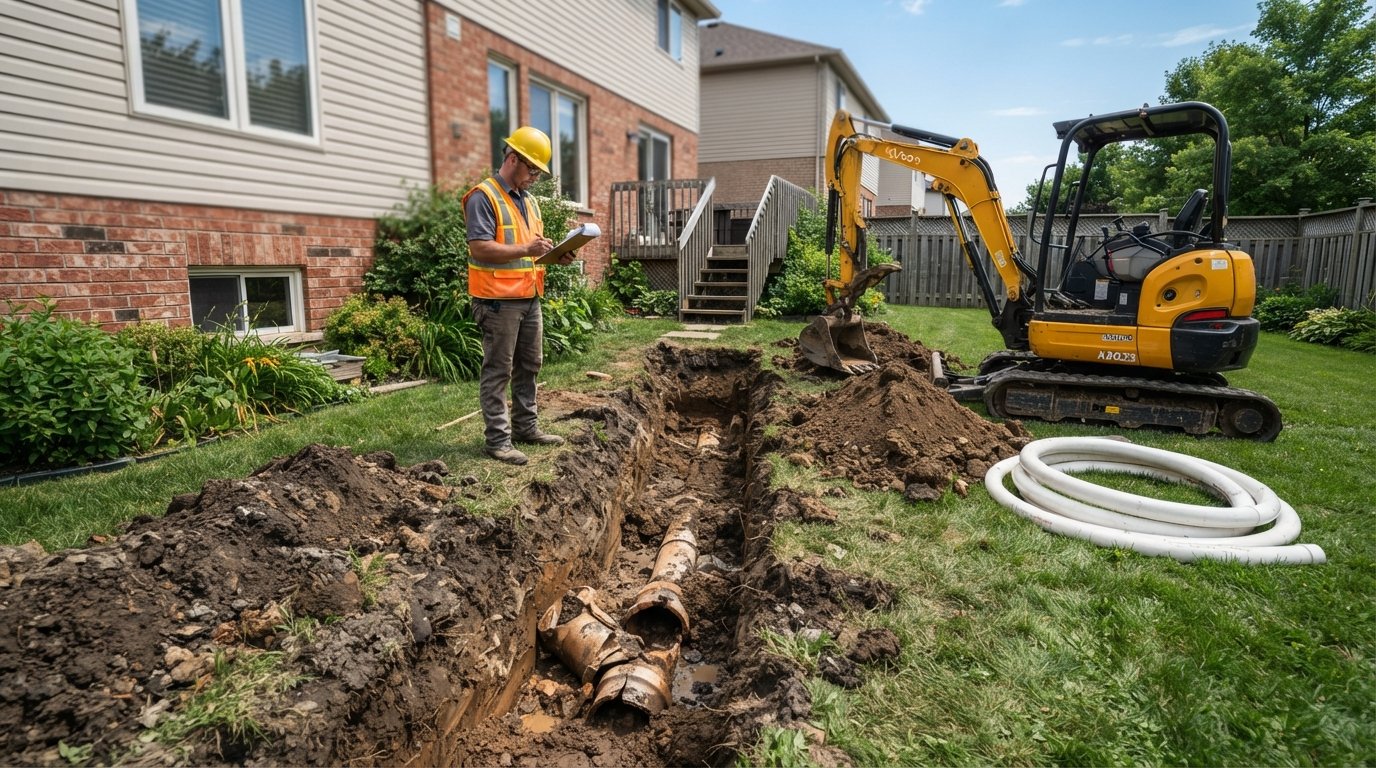
Pipe bursting is the other major trenchless option. A bursting head is pulled through the old pipe, breaking it outward while simultaneously pulling new high-density polyethylene pipe into the same path. It is faster than open excavation and preserves most of the yard, but it requires access pits at both ends and costs roughly $6,000 to $15,000. Open excavation remains the most common method for full replacement because it is straightforward, allows direct inspection of the new pipe and bedding, and handles any condition. It costs $8,000 to $25,000 or more, and the final number depends heavily on restoration: replacing a lawn is inexpensive, while replacing a concrete driveway or a stamped patio can add thousands.
The right choice depends on the camera findings, the pipe path, and your tolerance for disruption. A line that runs under a prized garden or a new driveway often justifies the premium for trenchless work. A line that runs through an open side yard with easy access may be cheaper to replace with open excavation. Discuss both options with your contractor and ask for a written comparison, including restoration costs, so you are comparing total project cost rather than just the excavation line item.
Permits, Right-of-Way, and Yard Restoration Costs
Permits are a frequently overlooked cost, and they vary widely by municipality. Most jurisdictions require a plumbing or right-of-way permit for main sewer line work, and fees commonly range from $50 to $500. Some cities also require an inspection of the connection at the municipal main, and a few require a licensed contractor to pull the permit, which affects who can legally do the job. Homeowners should confirm in writing who is responsible for the permit and inspection, because an unpermitted job can create problems when the home is sold.
Right-of-way issues arise when the sewer line crosses public property or an easement. If the repair or replacement extends into the street or sidewalk, the municipality may require a right-of-way permit, traffic control, and a licensed contractor with specific insurance. Those requirements add cost and time. In some cases, the utility or city owns the lateral up to the property line, which means the homeowner is responsible only for the portion on their property. Knowing where that boundary sits can save you thousands, so call the local sewer authority before approving any work.
Yard restoration is the other hidden line item. Open excavation leaves a trench that must be backfilled and compacted, and the surface must be restored. Basic grass seeding is inexpensive, but replacing sod, a sprinkler system, a fence, a patio, or a driveway can add $1,000 to $10,000. Ask every contractor to include restoration in the written scope and to specify what is and is not covered. A quote that looks $2,000 cheaper may simply exclude restoration that the other quotes include.
How to Budget and Vet Contractors for Sewer Replacement
Budgeting for a sewer replacement is easier when you separate the project into three buckets: the pipe work, the permits and inspections, and the restoration. Get itemized quotes that list each bucket, and keep a contingency of 10 to 20 percent for surprises such as hidden roots, unstable soil, or an unexpected utility line. Homeowners with older homes should also consider whether the line is shared with a neighbor or connects to a septic system, since those scenarios change both cost and responsibility.
Vetting contractors matters as much as comparing prices. Look for a licensed plumber or sewer contractor with specific experience in main line replacement, current insurance, and a track record you can verify. Ask for references from jobs similar to yours, confirm the permit will be pulled in the company's name, and insist on a written contract that specifies pipe material, length, depth, method, restoration, and warranty. A reputable contractor will welcome these questions and provide the camera footage, itemized estimate, and warranty terms in writing. You can also use a directory of pre-vetted local contractors to request multiple quotes and compare credentials side by side, which is exactly what Homes.Contractors provides for homeowners seeking qualified professionals.
Timing also affects cost. Emergency replacements on nights and weekends carry premium rates, and peak season demand can push prices higher. If the camera inspection shows a failing line but there is no active backup, you may have time to schedule the work during a slower period and collect several quotes. If sewage is backing up into the home, treat it as an emergency and prioritize getting a licensed crew on site, then verify the scope and warranty after the immediate danger is resolved.
Warning Signs You Should Not Ignore
Main sewer lines rarely fail without warning. The problem is that the warnings are easy to dismiss as minor annoyances until they become expensive emergencies. Knowing the signs helps you act before a small repair becomes a full replacement. The most common signals include repeated backups in the lowest drains, slow drainage throughout the house, gurgling sounds after flushing, sewage odors indoors or in the yard, and unusually lush or soggy patches of grass along the pipe path. A sudden spike in your water bill without a change in usage can also indicate a leak in the line.
If you notice any of these signs, schedule a camera inspection before authorizing repairs. The inspection costs a few hundred dollars and provides the evidence you need to choose the right fix. Homeowners who act on early warnings often spend far less than those who wait for a collapse, because they can choose the method, the timing, and the contractor rather than accepting whatever emergency service is available. The cost to replace a main sewer line is significant, but it is far more predictable when you plan ahead, gather itemized quotes, and verify the contractor's credentials before work begins.
Replacing a main sewer line is one of the larger expenses a homeowner can face, but it is also one of the most important investments in the long-term value and safety of a home. With a clear understanding of the cost drivers, a camera inspection in hand, and multiple written quotes from vetted professionals, you can move forward with confidence and protect your property from the damage that a failing sewer line can cause.