
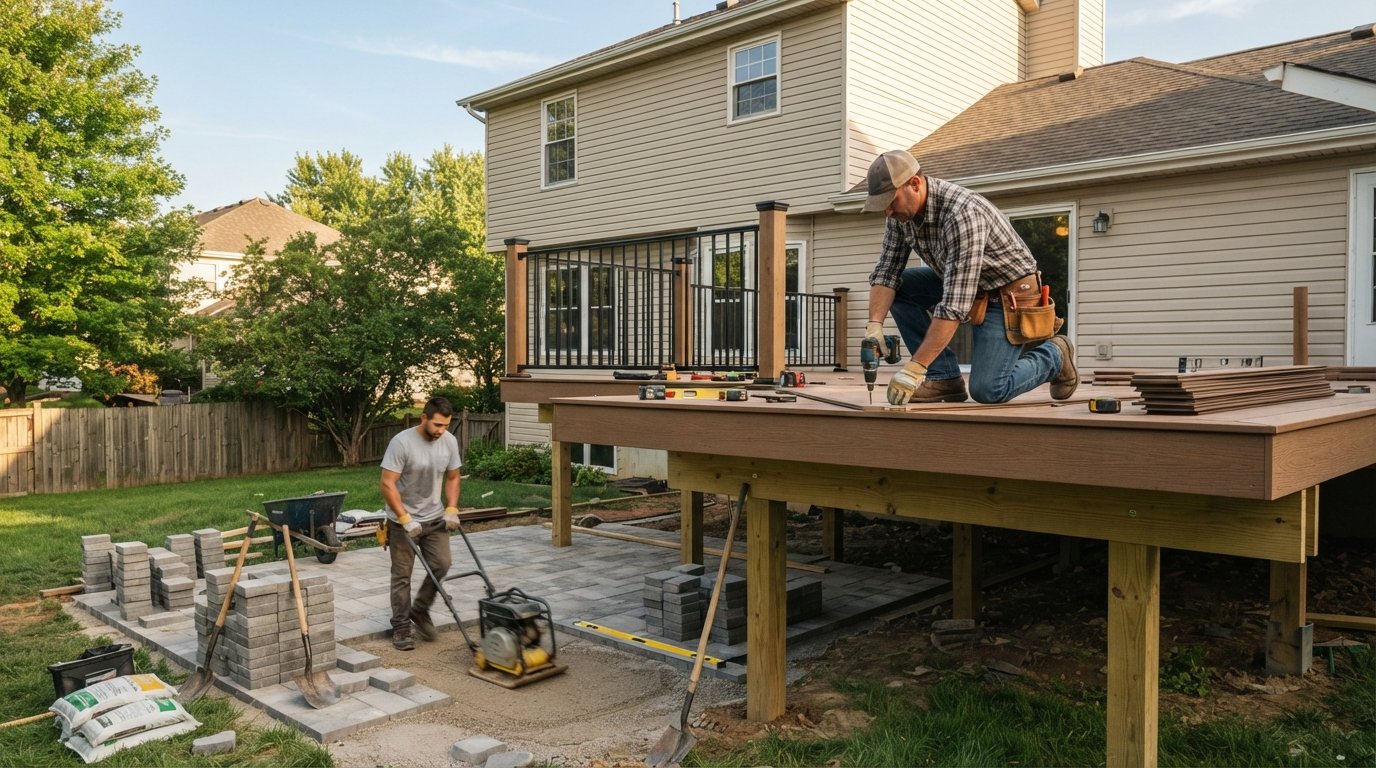
Building a Deck vs Patio: Which Outdoor Space Is Right for You?
Compare building a deck vs patio which outdoor space is right for you. Call (833)-700-4293 for expert guidance on costs, permits, and materials.

Learn more about Handyman for guides, costs, and what to expect.
Compare Handyman Pros Near You

Enter your ZIP code to compare top-rated local professionals and request free quotes.
Your backyard is a blank canvas, and you are ready to turn it into a functional outdoor living area. But before you start sketching furniture layouts and dreaming of summer barbecues, you face a fundamental choice: deck or patio? This decision shapes everything from your project budget to the permits you need and the long-term maintenance you will live with. The right answer depends on your home's grade, your local climate, how you plan to use the space, and how much upkeep you are willing to take on. This guide breaks down the real differences so you can move forward with confidence.
Deck vs Patio: The Core Differences at a Glance
At the most basic level, a deck is a raised wooden or composite structure attached to your house, while a patio is a hardscape surface installed at or near ground level. That structural distinction drives cost, permitting, and how each option performs on sloped lots. Decks rely on a framed substructure with footings, joists, and decking boards. Patios rely on a compacted base of gravel and sand topped with pavers, concrete, or stone. Understanding these fundamentals helps you evaluate which approach fits your property.
Homeowners often assume the choice is purely aesthetic, but the structural requirements usually dictate feasibility. A steeply sloped yard, for example, may make a patio expensive because of the retaining walls and grading required, while a deck can bridge that slope with posts and beams. Conversely, a flat lot with good drainage is a natural fit for a patio that sits flush with the lawn. The table below summarizes the key contrasts to keep in mind as you plan.
- Structure: Decks are elevated and framed; patios are ground-level hardscapes.
- Best for slopes: Decks handle grade changes more gracefully; patios need grading and retaining walls.
- Typical cost: Patios often cost less per square foot; decks cost more due to framing and footings.
- Permits: Decks almost always require permits; patios sometimes do, depending on local rules.
- Maintenance: Wood decks need staining and sealing; pavers need occasional re-sanding and cleaning.
These differences are not just technical trivia. They affect how long your project takes, how much you spend, and how the space feels when you step outside. A raised deck can create a seamless indoor-outdoor flow from a kitchen or living room, while a patio can extend your usable yard and connect naturally with landscaping. Keep both the practical and experiential factors in view as you read on.
Cost Per Square Foot, Slope, and Foundation Requirements
Budget is usually the first filter homeowners apply, and the cost gap between decks and patios can be significant. Patios generally run lower per square foot because they do not require a framed substructure. A basic concrete patio might start around $8 to $12 per square foot, while pavers or natural stone can push that to $15 to $30 or more. Decks, by contrast, typically start around $15 to $25 per square foot for pressure-treated wood and climb to $35 to $60 or higher for composite or hardwood. These are broad ranges, and local labor rates, material availability, and site conditions will move the numbers.
Slope is the wild card that often flips the cost equation. On a flat lot, a patio is usually the more economical choice because minimal site prep is needed. On a sloped lot, a patio may require extensive grading, fill, and retaining walls, which can add thousands of dollars. A deck can be built over the slope with posts of varying heights, often avoiding the need for major earthwork. Foundation requirements follow the same logic: decks need concrete footings set below the frost line, while patios need a stable, well-drained base that will not heave or settle.
Before you request quotes, walk your property and note the grade, drainage patterns, and any obstructions like tree roots or utility lines. These details will help contractors give you accurate estimates and reduce the chance of surprise change orders. It also helps to know the building codes that apply to additions in your area, since footing depth, setbacks, and structural requirements vary by state and municipality. For a deeper look at how local rules differ, see this guide on understanding building codes for home additions by state. Getting clear on these basics early will make your contractor conversations far more productive.
Material Options and Maintenance Expectations
The material you choose affects both the look of your outdoor space and the amount of time and money you will spend maintaining it. Decks offer a range of options, from traditional pressure-treated pine to cedar, redwood, and composite boards. Wood requires periodic cleaning, staining, and sealing, typically every one to three years, and it can warp, splinter, or fade over time. Composite decking costs more upfront but resists rot, insects, and fading, and generally needs only soap-and-water cleaning. Patios offer concrete, brick, flagstone, travertine, and interlocking pavers. Concrete is the most affordable but can crack; pavers are durable and repairable but need occasional re-sanding and weed control between joints.
Maintenance expectations often tip the decision for busy homeowners. If you want a low-maintenance surface, composite decking or high-quality pavers are worth the investment. If you enjoy the natural look of wood and do not mind an annual project, a wood deck can be a rewarding choice. Consider your climate as well: in wet regions, wood decks need more frequent sealing, while in freeze-thaw climates, patios need a properly compacted base to prevent heaving.
Here is a quick comparison of common materials to help you weigh the trade-offs:
- Pressure-treated wood: Affordable, needs annual sealing, prone to splinters over time.
- Cedar or redwood: Naturally rot-resistant, beautiful, requires periodic staining.
- Composite decking: Low maintenance, higher upfront cost, resists fading and insects.
- Concrete patio: Economical, can crack, minimal routine maintenance.
- Pavers or stone: Durable, repairable, needs occasional re-sanding and cleaning.
Whichever material you choose, plan for the long-term cost of upkeep, not just the installation price. A deck that needs repainting every few years may cost more over a decade than a patio that only needs an occasional power wash. Factor maintenance into your budget from the start so you are not caught off guard.
Climate, Drainage, and How Your Lot Performs
Climate and drainage are often the deciding factors that homeowners overlook until problems appear. In areas with heavy rainfall, a patio must be sloped away from the house and built on a base that drains well, or water will pool and undermine the surface. Decks shed water through the gaps between boards, but the ground beneath must still drain properly to prevent rot and mosquito breeding. In cold climates, frost heave can crack concrete and shift pavers, while deck footings must be set below the frost line to prevent movement.
Hot, dry climates favor patios because they do not rot or splinter, and materials like concrete and stone stay relatively cool when shaded. However, wood decks can become uncomfortably hot in direct sun, and composite boards can also heat up. In humid regions, wood decks are more vulnerable to mold and decay, making composite or patio materials more attractive. Wind exposure matters too: elevated decks may need additional bracing, while patios are generally more stable in high-wind areas.
Drainage is not just about keeping your outdoor space dry; it is about protecting your foundation. If your yard holds water, a patio may need a French drain or dry well, and a deck may need grading beneath it. Before you commit, observe your yard during a heavy rainstorm and note where water flows and pools. This simple step can save you from expensive fixes later and help you choose the option that works with your lot rather than against it.
Permits, Setbacks, and Local Rules
Permitting is one of the most practical differences between decks and patios. Because decks are structures attached to your home, they almost always require a building permit, and the plans may need to be stamped by an engineer or architect. Inspections typically cover footings, framing, and final construction. Patios, being ground-level hardscapes, often fall under different rules: some municipalities require permits for patios above a certain size or when they are attached to the house, while others do not require permits at all. Setback rules also differ: decks must respect property line setbacks and height restrictions, and patios may have their own setback and impervious surface limits.
Ignoring these rules can be costly. Unpermitted work can complicate a future home sale, trigger fines, or require removal. Before you build, call your local building department or check their website for the specific requirements in your area. Ask about setback distances, maximum height, impervious surface coverage, and whether your project needs a survey. If you are unsure, a reputable contractor can help you navigate the process, but the responsibility ultimately rests with you as the homeowner.
It also helps to understand how your project fits into the broader code landscape for home additions. Rules for footings, structural loads, and egress vary widely, and what is allowed in one town may be restricted in the next. Taking the time to verify requirements upfront will keep your project on schedule and avoid nasty surprises during inspection.
Planning Questions Before You Request Contractor Quotes
Once you have a sense of the trade-offs, the next step is to translate your priorities into a clear project scope. Contractors give better estimates when you can describe what you want, your budget range, and any site constraints. Before you start calling, answer a few key questions about how you plan to use the space and what you can realistically spend.
- How will you use the space? Dining, lounging, cooking, or a mix? This affects size, layout, and whether you need built-in features.
- What is your total budget, including permits and site prep? Set a comfortable range and a hard ceiling.
- How much maintenance are you willing to do? Be honest about your time and willingness to seal, stain, or re-sand.
- What does your lot allow? Note slope, drainage, setbacks, and any HOA restrictions.
- Do you need permits, and who will handle them? Confirm whether your contractor pulls permits or expects you to.
With these answers in hand, you can request multiple quotes and compare them apples to apples. Make sure each quote itemizes materials, labor, permits, and site prep so you can spot missing costs. Ask about timelines, warranties, and what happens if the project encounters unexpected issues like buried utilities or rocky soil. A thorough comparison now prevents headaches later.
When you are ready to find qualified professionals, using a directory of pre-vetted contractors can save time and reduce risk. You can browse vetted home improvement contractors to request estimates from local pros who have experience with both decks and patios. Getting multiple bids is one of the best ways to ensure you are paying a fair price for quality work.
Making the Final Call: Matching the Space to Your Life
The deck versus patio decision rarely comes down to a single factor. It is a balance of budget, site conditions, maintenance tolerance, and how you want to feel when you step outside. If you have a sloped lot and want a seamless connection to your home, a deck may be the natural choice. If you have a flat yard, want minimal maintenance, and prefer a surface that integrates with landscaping, a patio likely makes more sense. Neither option is inherently better; the right one is the one that fits your property and your lifestyle.
Take the time to walk your yard, talk to contractors, and compare quotes before you commit. A well-planned outdoor space adds value to your home and enjoyment to your daily life, and the effort you put into planning now will pay off for years to come.