
Living in Your House During a Kitchen Remodel: A Survival Guide
Living in your house during a kitchen remodel is manageable with smart strategies. Call (833)-700-4293 to find trusted contractors and keep your project on track.

By Elena Carter
Learn more about Kitchen Remodel for guides, costs, and what to expect.
Compare Kitchen Remodel Pros Near You

Enter your ZIP code to compare top-rated local professionals and request free quotes.
Your kitchen is the heart of your home, but when the remodeling crew arrives, that heart becomes a construction zone. The idea of living in your house during a kitchen remodel can feel overwhelming: dust everywhere, no running water, and the constant noise of saws and hammers. Yet for many homeowners, staying put is the only practical or financial option. The good news is that with careful planning and a few clever strategies, you can minimize the chaos and keep your household running smoothly. This guide walks you through the essential steps to survive and even thrive while your kitchen is under construction.
Set Up a Temporary Kitchen That Actually Works
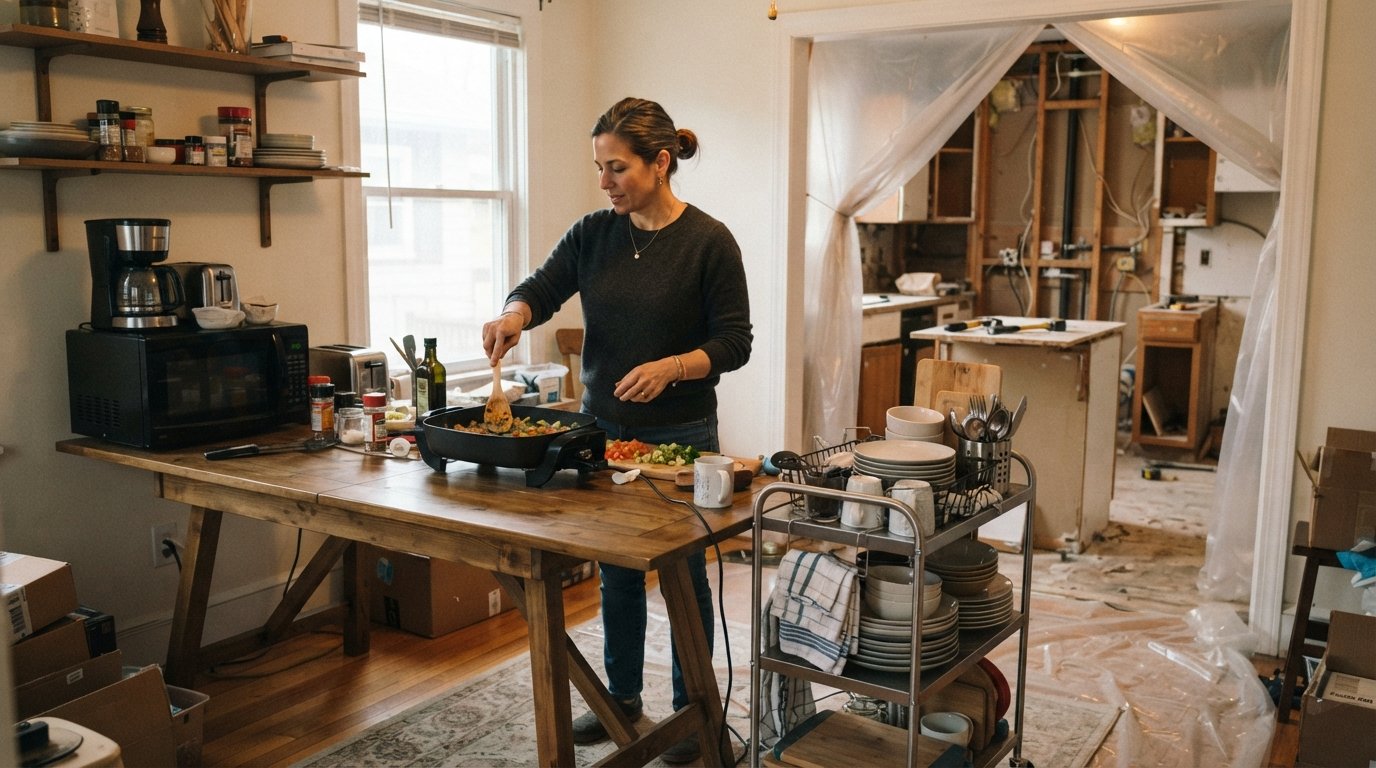
The first step to maintaining your sanity is creating a functional temporary kitchen. You do not need a full second kitchen, but you do need a dedicated space with the essentials for preparing simple meals. Choose a room adjacent to the kitchen, such as a dining room or a corner of the living room, and clear it of clutter. A folding table works well as a prep surface, and a small cart can hold frequently used items. Think about what you use daily: a microwave, a coffee maker, a toaster, and perhaps a slow cooker or electric skillet. These appliances can handle most basic cooking tasks without requiring a full stove.
Stock your temporary kitchen with a limited set of dishes, utensils, and cookware. Paper plates and disposable cutlery can reduce dishwashing, but they generate waste; consider using a small set of reusable items and washing them in a temporary dishwashing station. For washing up, set up a large plastic tub as a sink. You can fill it with water from the bathroom or utility sink, add a drop of dish soap, and wash dishes in batches. Rinse water can be poured outside or down a drain if permitted. This station should be near your temporary kitchen for convenience.
Organization is key. Use clear plastic bins to group items by category: one for dry goods, one for utensils, one for spices. Label each bin so family members can find what they need without rummaging. Keep a small fire extinguisher nearby, as temporary cooking setups can pose fire risks. Also, ensure you have a cooler or a small refrigerator for perishables if your main fridge is unplugged or moved. Some families invest in a mini-fridge to keep milk, eggs, and produce fresh. With a little creativity, your temporary kitchen can become a cozy hub for simple meals and family bonding.
Control Dust with Barriers and Negative Air Pressure
Dust is the uninvited guest of any remodel. It settles on every surface, clogs HVAC filters, and can aggravate allergies. To keep dust contained, professional contractors often use plastic barriers and negative air pressure. You can ask your crew to set up these measures, or do it yourself if you are handy. Start by sealing off the kitchen from the rest of the house using plastic sheeting. Use zipper doors for easy access, and tape the edges securely. This creates a physical barrier that stops dust from spreading.
Negative air pressure is a technique that uses a fan to pull air out of the kitchen, preventing dust from escaping into other rooms. A simple setup involves placing a box fan in a window of the kitchen, blowing outward. This creates a slight vacuum that draws air from the rest of the house into the kitchen, keeping dust inside. Make sure the fan is sealed around the window opening with plastic or cardboard. If your contractor has a HEPA air scrubber, even better; these machines filter fine particles and are standard on many job sites. Do not rely on a single barrier; use multiple layers if possible, and keep doors closed.
Beyond barriers, protect your belongings. Cover furniture in adjacent rooms with plastic drop cloths, and remove or cover rugs. Seal off HVAC vents in the kitchen and nearby areas to prevent dust from circulating through your heating and cooling system. Change your HVAC filter more frequently during the remodel, perhaps every two weeks. After the work is done, do a deep clean, including wiping down walls and ceilings, to remove settled dust. These steps will significantly reduce the cleanup burden and help you breathe easier.
Negotiate Working Hours and Quiet Periods with Your Crew
Communication with your contractor is essential for a harmonious remodel. Before work begins, discuss the daily schedule and set clear expectations for working hours. Most crews start early, often around 7 or 8 a.m., and finish by late afternoon. If you have young children, work-from-home commitments, or need quiet time, negotiate a schedule that accommodates your needs. For example, you might ask for noisy work to be concentrated in the morning, with quieter tasks in the afternoon. Some contractors are flexible and will work with you to minimize disruption.
Establish a quiet period, perhaps during lunch or nap time, when no loud machinery is used. This can be a win-win: workers get a break, and you get peace. Also, clarify which days will be the most disruptive. Demolition day, for instance, is typically loud and dusty; plan to be out of the house or in a distant room. Ask your contractor to give you a weekly schedule so you can plan around major milestones. If you have pets, discuss how to keep them safe and calm during construction. A scared dog barking at workers is stressful for everyone.
Remember that your contractor wants the job to go smoothly, too. A respectful, collaborative relationship often leads to better outcomes. Small gestures, like providing coffee or cold water, can build goodwill. But do not hesitate to set boundaries: if workers arrive too early or leave a mess, speak up politely. A written agreement about working hours and cleanup can prevent misunderstandings. By establishing clear communication from the start, you create a more predictable environment and reduce the stress of living through a remodel.
Plan for Bathroom and Laundry Access When Utilities Are Shut Off
One of the biggest challenges of living in your house during a kitchen remodel is losing access to water and appliances. Often, the water supply to the kitchen sink and dishwasher will be shut off for days or weeks. If your only bathroom is adjacent to the kitchen, you might face temporary shutdowns there as well. Plan ahead by identifying alternative facilities. If you have a second bathroom, designate it as the primary one during the remodel. If not, talk to your contractor about scheduling water shutoffs for short periods and giving you advance notice.
Laundry can also be disrupted if your washer and dryer are in or near the kitchen. If possible, move laundry tasks to a laundromat during the remodel, or ask your contractor to keep the laundry area accessible. Sometimes, appliances can be temporarily relocated, but this adds cost and complexity. For many families, the simplest solution is to do laundry at a relative's house or a nearby laundromat. Budget for this expense; it is a small price for convenience.
Consider your daily routines. Without a kitchen sink, you will need a place to wash hands and dishes. The bathroom sink can handle handwashing, but avoid pouring grease or food scraps down it, as this can clog pipes. Use the temporary dishwashing station described earlier. For drinking water, set up a water filter pitcher or buy bottled water. Keep a supply of paper towels and disinfecting wipes handy. If you have a utility sink in the basement or garage, that can be a lifesaver for cleaning up. With some planning, you can manage without full kitchen utilities and keep your household running.
Know When Moving Out Temporarily Is the Cheaper Choice
For some families, staying in the house during a kitchen remodel is not feasible or cost-effective. If the remodel is extensive, involving major structural changes or whole-house utilities, the disruption may be too great. In such cases, moving out temporarily might actually save money and reduce stress. Consider the costs of staying: eating out more often, purchasing disposable supplies, and potential damage to belongings from dust. These expenses can add up quickly. On the other hand, renting a short-term apartment or staying with family has its own costs, but it may be offset by reduced stress and faster project completion.
To decide, create a budget for both scenarios. If you stay, estimate increased food costs (perhaps $20 to $40 per day for a family), laundry expenses, and any temporary kitchen setup costs. If you leave, factor in rent, utility savings at home, and the cost of moving and storing belongings. Also, consider the timeline: a minor remodel might take three weeks, while a major one could take three months. The longer the project, the more likely moving out makes financial sense. Some contractors offer discounts for unoccupied homes because they can work faster without interruptions. Ask your contractor if an empty house would shorten the schedule.
Another factor is your personal tolerance. If you have a young child, a pet, or a home-based business, the chaos might be unbearable. Moving out can be a wise investment in your well-being. Before deciding, consult with your contractor and perhaps a financial advisor. A trusted resource like Homes.Contractors can help you find and vet local professionals who understand your needs and can provide accurate timelines and cost estimates. Their directory covers kitchen remodeling and more, making it easier to plan your project with confidence.
Budgeting for the Chaos: Financial Tips for Living Through a Remodel
Living through a kitchen remodel can strain your wallet if you are not prepared. Beyond the construction costs, there are everyday expenses that creep up. Budget for eating out more frequently, even if you plan to cook in your temporary kitchen. It is easy to underestimate how often you will opt for takeout when you are tired of microwave meals. Set aside a weekly allowance for dining out and stick to it. Also, consider the cost of disposable plates, utensils, and cleaning supplies; these add up over weeks.
If you need to hire a contractor, get multiple quotes to ensure you are getting a fair price. PlanRemodel.com can connect you with pre-vetted local contractors who offer free estimates, helping you compare options and avoid overpaying. For a deeper dive into budgeting, read our guide on how to set a realistic kitchen remodel budget; it covers contingency planning and hidden costs. Remember that the cheapest bid is not always the best; quality and reliability matter, especially when you are living on-site.
Track your expenses during the remodel. Keep receipts for any temporary purchases, as some may be tax-deductible if you are remodeling for medical reasons or home office use (consult a tax professional). Also, check your homeowner's insurance policy: some policies cover additional living expenses if your home is uninhabitable due to a covered peril, but remodeling is typically not covered. Do not assume; read your policy or call your agent. Finally, build a small emergency fund for unexpected issues, like a broken temporary appliance or a need for extra takeout. A financial buffer reduces stress and helps you focus on the end result: a beautiful new kitchen.
Living in your house during a kitchen remodel is a test of patience and organization, but it is entirely doable with the right approach. By setting up a functional temporary kitchen, controlling dust, communicating with your crew, and planning for utility outages, you can minimize disruption. And if the chaos becomes too much, remember that moving out temporarily is a valid option that might even save money. With careful budgeting and a positive mindset, you will soon be enjoying your new kitchen, grateful for the journey that got you there.