
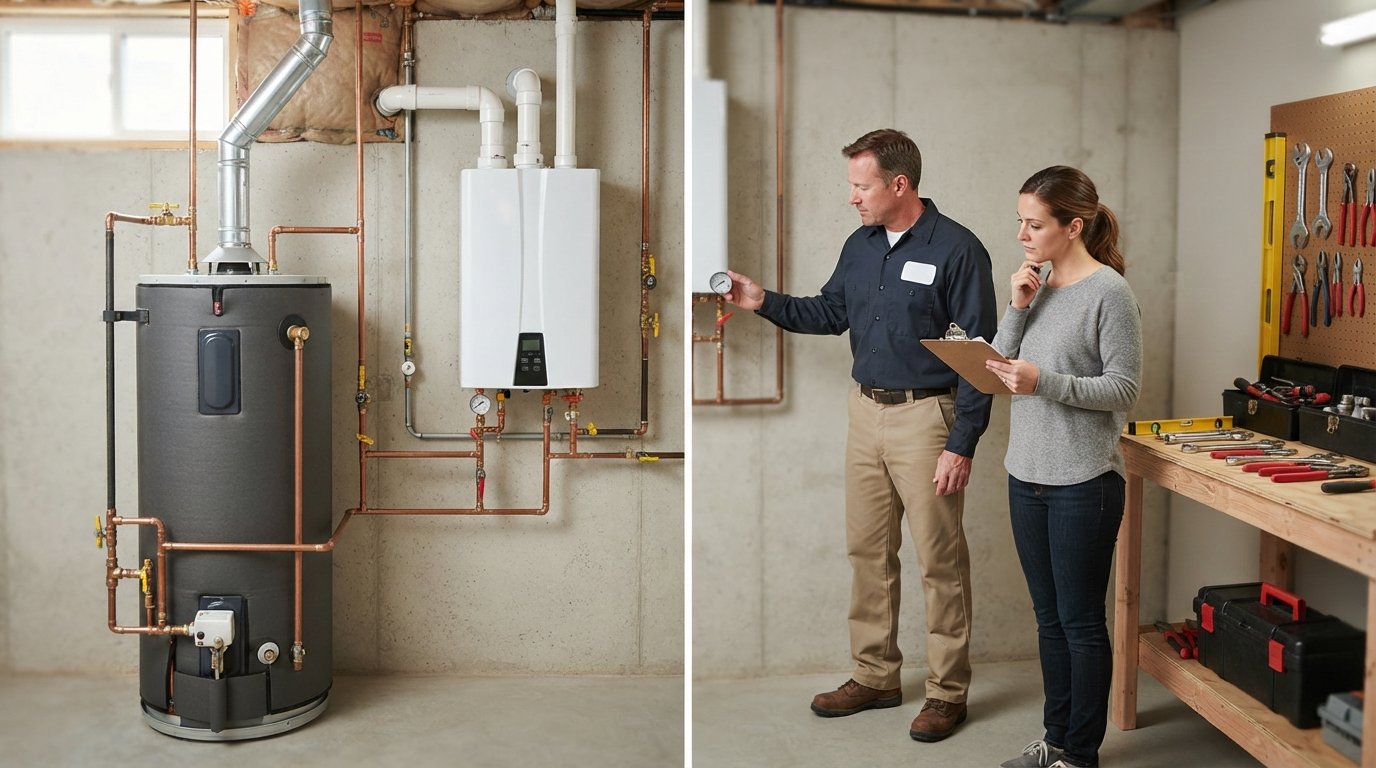
Tankless Versus Tank Water Heater: A Decision Guide
Compare tankless versus tank water heater costs, savings, and sizing. Call (833)-700-4293 to get matched with local plumbing pros.

Learn more about Water Heater Repair or Maintenance for guides, costs, and what to expect.
Compare Water Heater Repair or Maintenance Pros Near You

Enter your ZIP code to compare top-rated local professionals and request free quotes.
Replacing a water heater is one of those home projects that sneaks up on you, usually at the worst possible time. One morning the shower runs cold, the basement floor is wet, and suddenly you are comparing tankless versus tank water heater options while a contractor waits for an answer. The pressure is real, and the price gap between the two is wide. A standard tank unit might run $800 to $1,500 installed, while a tankless system can easily land between $2,500 and $4,500 once venting and gas line work are included. That difference deserves a clear-eyed look, not a sales pitch.
This tankless versus tank water heater decision guide walks through the numbers that actually matter: upfront cost, long-term energy savings, installation extras, hot water capacity, maintenance, and lifespan. By the end, you should know which system fits your household, your climate, and your budget, and you will know what to ask a plumber before signing anything. For homeowners who want to compare pre-vetted local plumbing pros side by side, resources like Homes.Contractors can help you gather multiple quotes before you commit.
How the Two Systems Actually Work
A conventional tank water heater stores 40 to 80 gallons of water in an insulated cylinder and keeps it hot around the clock, ready for the next shower or load of dishes. That standby heat loss is the efficiency penalty you pay for instant availability. A tankless, or on-demand, heater skips the storage entirely. Cold water passes over a high-powered burner or heating element and arrives hot within seconds. No tank means no standby loss, and the unit only consumes energy when a faucet is open.
That difference sounds like a clear win for tankless, and in many cases it is. But the engineering has consequences. A tankless unit must heat water fast enough to satisfy every fixture drawing at once, which means sizing is critical and the unit must be matched to the household's peak demand. A tank heater, by contrast, buffers demand with stored volume, so a 50-gallon tank can serve several showers in sequence even if the recovery rate is modest. Understanding that trade-off is the foundation of any honest tankless versus tank water heater comparison.
There is also a fuel split to consider. Tank units run on natural gas, propane, or electricity. Tankless models come in gas and electric versions too, but electric tankless units draw enormous amperage and often require dedicated circuits or a service panel upgrade. Gas tankless units need a larger gas line and, in most cases, stainless steel venting. Those installation realities drive much of the cost gap, and they are where many upgrade budgets quietly blow up.
The Real Math: Upfront Cost Versus Long-Term Savings
Start with purchase and installation. A 50-gallon gas tank heater typically costs $800 to $1,500 installed, including hauling away the old unit. A comparable gas tankless heater runs $2,500 to $4,500 installed once you factor in venting, gas line upgrades, and labor. Electric tankless can be cheaper on the unit itself but often triggers a panel upgrade that adds $1,000 to $2,500. So the realistic upfront premium for going tankless is usually $1,500 to $3,000.
Now the savings side. Tankless units are roughly 22 to 34 percent more efficient than standard tank models for gas, according to federal energy guidance, largely because they avoid standby losses. On a typical household gas bill, water heating runs about $400 to $600 per year. A 25 percent efficiency gain saves roughly $100 to $150 annually. Divide a $2,500 premium by $150 in yearly savings and the payback period stretches past 15 years, which is longer than many tankless units last. The financial case improves if you already need a gas line upgrade, if you live in a high-energy-cost region, or if you plan to stay in the home for decades.
Here is a simple way to frame the decision before you call a contractor:
- Short stay (under 7 years): A conventional tank usually wins on total cost of ownership.
- Long stay with high hot water use: Tankless savings and lifespan start to close the gap.
- Limited space or no basement: Tankless frees up square footage and can be wall-mounted.
- Tight upfront budget: A tank replacement keeps cash available for other repairs.
Notice that none of these rules is absolute. The right answer depends on how long you will own the home, how much hot water you use, and what installation surprises your house holds. A plumber who runs the actual numbers for your address is worth more than any generic calculator.
Installation Upgrades Tankless Often Requires
This is the part of the tankless versus tank water heater conversation that homeowners underestimate most. A tank heater is often a drop-in replacement for the unit it replaces: same footprint, same vent, same gas line. A tankless unit is a different animal, and the house frequently needs modification before it can be installed.
Gas line sizing is the first hurdle. Tankless burners pull 150,000 to 200,000 BTUs per hour, far more than a tank unit's 40,000 BTU draw. If the existing gas line is half-inch pipe, it may need to be upsized to three-quarter inch or larger, which means running new pipe through walls or along the exterior. Venting is the second hurdle. Standard tank units vent through a metal flue; high-efficiency tankless units need category III stainless steel venting or PVC, depending on the model, and the vent run must meet clearance rules for windows, doors, and property lines. In older homes, that can mean a new penetration through the roof or sidewall.
Electrical work rounds out the list. Gas tankless units still need a 120-volt circuit for controls and ignition, which is usually simple. Electric tankless units are a different story: a whole-house electric model can draw 120 amps or more, which may require a service panel upgrade and new dedicated circuits. Condensate management is another detail. High-efficiency condensing tankless units produce acidic condensate that must be drained or neutralized, adding a small but real plumbing cost.
Before you choose, ask a licensed plumber to inspect the following and quote each item separately:
- Existing gas line diameter and run length to the heater location.
- Vent termination options and local clearance requirements.
- Electrical panel capacity and available circuits.
- Water hardness, which affects scale buildup and maintenance intervals.
- Whether a recirculation loop is needed to speed hot water delivery.
Getting these five items priced in writing is the single best defense against a mid-project cost overrun. It also gives you apples-to-apples quotes when you compare contractors, which is exactly the kind of transparency PlanRemodel's referral model is built around.
Sizing and Hot Water Output Limits
Tankless sizing is measured in flow rate, typically gallons per minute, and temperature rise. A unit rated for 8 gallons per minute at a 35-degree rise will deliver far less if the incoming water is 45 degrees in winter and you want 120-degree showers. In cold climates, that derating can turn an apparently adequate unit into an undersized one. The practical result is a familiar tankless complaint: the shower runs warm until someone starts the dishwasher, and then it runs cold.
Sizing starts with a fixture count. A typical shower draws about 2.5 gallons per minute, a kitchen faucet about 1.5, and a dishwasher or washing machine roughly 1 to 2. Add up the fixtures you expect to run simultaneously and match the unit's rated flow at your coldest incoming water temperature. Households with two or more simultaneous showers, or with a large soaking tub, often need a larger unit or a condensing model with a higher capacity. Some families solve the problem with two smaller units, one for each bathroom zone, though that doubles the installation cost.
Tank heaters face a different limit. A 50-gallon tank delivers a fixed volume, then recovers at roughly 40 gallons per hour for gas. A family of four that showers back to back may drain the tank, but the wait for recovery is predictable and the system never runs out mid-shower in the same jarring way. For households with high simultaneous demand, a tank can be the more forgiving choice even if it is less efficient. Matching the system to actual usage patterns matters more than chasing the highest efficiency rating on the box.
Maintenance and Expected Service Life
Tankless units are not maintenance-free, and that surprises many buyers. Because water passes through a heat exchanger, mineral scale accumulates faster in hard water areas. Manufacturers typically recommend flushing the unit with vinegar or a descaler once a year, and in very hard water, every six months. Skipping that flush shortens the unit's life and can void the warranty. Tank heaters need attention too, mainly draining sediment annually and replacing the anode rod every few years, but those tasks are simpler and less frequent.
Lifespan favors tankless on paper. A well-maintained tankless unit can last 20 years, while a tank heater typically lasts 8 to 12. In practice, the gap narrows in hard water regions where neglected tankless units fail early, and widens in soft water areas with diligent maintenance. Repair costs also differ: tankless heat exchangers and circuit boards are expensive to replace, while tank failures usually mean a full unit replacement rather than a repair.
Budget for service either way. A reasonable annual maintenance allowance is $100 to $200 for tankless descaling and $50 to $100 for tank flushing. Homeowners who travel frequently or who have very hard water should lean toward the simpler tank system unless they are committed to the annual service routine.
When a Conventional Tank Remains the Smarter Buy
Despite the efficiency headlines, a tank heater is often the better financial decision. If you are selling the home within a few years, the tankless premium will not pay back before you move. If your gas line and venting would need major rework, the installed cost gap can exceed $4,000, and the efficiency savings will never catch up. If your household runs several hot water fixtures at once, a tank with adequate volume may perform better than a marginally sized tankless unit.
Emergency replacements also favor tanks. When a heater fails on a Friday night, a tank unit can usually be installed the next day from local stock. Tankless units often require ordering, inspection, and permit scheduling, which can leave a family without hot water for a week or more. Homeowners on tight budgets, or those planning a larger remodel in the next few years, may prefer to keep the replacement simple and invest the savings elsewhere.
There is no universal winner in the tankless versus tank water heater decision guide. The right choice comes down to your timeline, your household demand, your home's existing infrastructure, and your willingness to maintain the equipment. Get two or three written quotes that itemize the extras, ask each contractor to explain the sizing math, and verify licensing and insurance before work begins. A few hours of comparison shopping can save thousands and keep the hot water flowing for years.